

If you have just finished BTech and are asking which course is best after BTech, you are not alone. Many students feel stuck at this point.
You have two options. You can go for a job right away. Or you can study a specialised course that makes you job-ready for a particular field.
A job-focused course is often the faster path. It gives you skills that companies ask for, which your degree alone may not cover. Below are six courses that lead to real jobs in India and the Gulf.
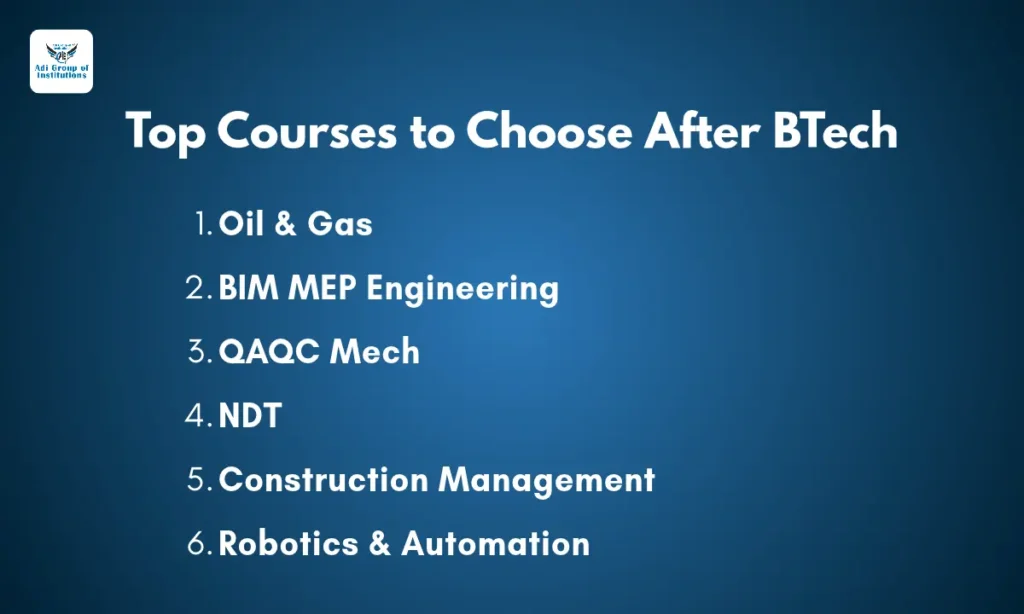
The oil and gas industry runs on engineers. This course teaches you how crude oil is found, drilled, processed, and moved to refineries. You learn about upstream, midstream, and downstream operations, plus plant safety and pipeline basics.
The work is a mix of site and office duty. Many jobs are at refineries, offshore rigs, or plants. Safety rules are strict, and the pay is good because the work carries responsibility.
Chemical, Mechanical, and Petroleum Engineering are the best BTech streams for Oil & Gas, as they match the core jobs in refining, equipment, and drilling.
Most freshers start at around ₹3 to ₹5 LPA in India. Gulf jobs usually pay more.
Future job roles: Process engineer, safety officer, piping engineer, drilling engineer, production engineer.
BIM stands for Building Information Modelling. MEP stands for Mechanical, Electrical, and Plumbing. In this course, you learn to make 3D models of the systems inside a building, such as air conditioning, wiring, and water lines.
You work on software like Revit and AutoCAD. Most of your day is spent at a computer, coordinating with architects and site teams. You find clashes in the design before construction starts, which saves a lot of money.
If you have completed BTech in Mechanical, Electrical, or Civil Engineering, the BIM MEP course is a good fit
Average starting salary is around ₹3 to ₹6 LPA, and Gulf projects pay more.
Future job roles: BIM modeller, MEP design engineer, BIM coordinator, MEP draftsman.
QAQC means Quality Assurance and Quality Control. This course trains you to check that mechanical work meets the required standards. You learn about welding, piping, inspection methods, and quality documents.
As a QAQC engineer, you spend time on site. You inspect materials, review welds, and prepare reports. Every project in oil and gas, power, and construction needs this role.
If you have completed BTech in Mechanical Engineering, QAQC is the best fit.
The average starting salary is about ₹2.5 to ₹5 LPA. With experience and certifications, it rises quickly.
Future job roles: QAQC engineer, quality inspector, welding inspector, document controller.
NDT is a way to test a material or a weld without damaging it. You learn methods like ultrasonic testing, radiography, magnetic particle testing, and dye penetrant testing. Industries use these to find hidden cracks before they cause accidents.
The job is hands-on and mostly on site. You travel to plants, refineries, and shipyards. Your certification level, such as Level I or Level II, decides your pay and role.
Mechanical, Metallurgy, and Production Engineering are the most suitable BTech streams for NDT.
Starting pay is around ₹2.5 to ₹4.5 LPA. Gulf jobs pay much better.
Future job roles: NDT technician, NDT inspector, Level II or Level III NDT engineer, integrity inspector.
This course teaches you how to run a construction project from start to finish. You learn planning, cost control, scheduling, contracts, and site safety. You also learn tools like Primavera and MS Project.
The job mixes office planning with site visits. You make sure the project finishes on time and within budget. It suits civil and mechanical graduates who want to move into a leadership role.
If you have completed BTech in Civil Engineering, Construction Management is the best fit, and Mechanical, Electrical, and Architecture graduates can also do well, since the work involves planning, costing, and running a project from start to finish.
Average starting salary is around ₹4 to ₹8 LPA.
Future job roles: Project engineer, planning engineer, site manager, quantity surveyor, project manager.
This course covers how machines are programmed to work with little human help. You learn about PLC, SCADA, sensors, robotic arms, and industrial control systems. It suits students from CSE, ECE, EEE, and mechanical branches.
Most jobs are in manufacturing plants, warehouses, and automation companies. You design, program, and maintain automated systems. The field is growing as more factories automate their work.
Mechatronics, Electronics and Communication, Electrical, and Mechanical Engineering are the most suitable BTech streams for Robotics & Automation. CSE graduates also fit well, especially for programming and software-side roles.
Average starting salary is around ₹4 to ₹8 LPA.
Future job roles: Automation engineer, PLC programmer, robotics engineer, control systems engineer.
A CSE student and a mechanical student will not have the same best fit. Pick a course that connects to what you already know and enjoy. If you are looking for the best course after BTech CSE, automation and robotics fit more easily than site-based courses like NDT.
Search job portals like Naukri, LinkedIn, and Indeed for the role you want. If you see many openings in India and the Gulf, that is a good sign.
Compare the fees, the course length, and the salary you can expect. A short course that leads to a job is often better value than a long one that does not.
Ask the institute where past students are working. Ask for real company names. A good course should help you with interviews and placements.
Some jobs are on site, some are in an office, and some need travel. Think about what suits you before you pay the fees.
Oil and Gas, Construction Management, and Robotics & Automation usually offer higher pay. Gulf jobs in oil and gas and NDT pay even more. Salary also depends on your skills, certifications, and the company you join.
Robotics & Automation is a good fit, since it uses programming and logic. BIM is also a good choice if you like working on design software. Oil and Gas is possible too, but it is a bigger change from your CSE background.
Yes. Courses in Oil and Gas, BIM MEP, QAQC, and NDT are short-term and job-focused. Most take a few months. They add practical skills to your degree and help you get your first job faster.
It depends on your skills and goals. If you already have strong skills, apply for jobs. If companies ask for practical skills you do not have, a short course can help you get hired faster.
Yes. Gulf companies prefer candidates with practical, industry-specific training. Courses like Oil and Gas, QAQC, NDT, and BIM MEP are in demand there. Certifications also help you get better pay.
There is no single best answer to which course is best after BTech. The right choice depends on your branch, your interest, and the job you want.
Oil and Gas, BIM MEP, QAQC, NDT, Construction Management, and Robotics & Automation all lead to real jobs. Compare the job demand, the cost, and the placement support before you decide.
If you want a career in oil and gas, Adi Institute offers a job-oriented course in Kochi. You can talk to the team to understand if it suits your background.

Adi Institute is a leading educational institution in Kerala, committed to equipping learners with knowledge, skills, and innovation for the future. With experienced educators, modern facilities, and dedication to excellence, it offers a transformative learning experience that inspires growth, confidence, and career success.
Founded in 2014, Adi Group of Institutions offers job-oriented management and technical courses, equipping students with industry-relevant skills and providing 100% job assistance for successful career placement.
| [ninja_form id=2] |
WhatsApp us

