

After BSc, which course is best? There is no single best course for every student. The best course is the one that fits your skills, your interests, and the job you want. This guide shows six good options and how to pick the right one.
If you just finished a BSc, you may feel confused right now. BSc alone does not always lead to a job. It teaches you the basics of science and builds your thinking and problem-solving skills. There are many diploma courses in Kerala are available.
The right course depends on three things:
Your subject: What you studied in BSc decides which courses suit you best.
Your interest: You will work in this field for years, so pick something you enjoy.
Your goal: You may want a quick job, a Gulf job, higher studies, or a government job. Each goal needs a different course.
Now let us look at the best courses after BSc.

After completing a science degree, if you want to work in hospitals, you can choose hospital administration. Hospital administration is the process of managing day-to-day operations in a hospital.
The course trains you to run the non-clinical side of a hospital, such as patient registration, billing, insurance claims, staff coordination, and quality checks. You can start as a patient care coordinator, medical billing executive, TPA coordinator, or medical records officer, and with experience move up to department manager or hospital operations manager.
Average salary after a hospital administration course is 3 – 5 LPA.
Cybersecurity is one of the highest-paying careers after BSc. Cybersecurity professionals monitor security threats, identify system vulnerabilities, investigate suspicious activities, and implement security measures to prevent cyberattacks. Career opportunities in cybersecurity include Cybersecurity Analyst, Ethical Hacker, Security Engineer, Penetration Tester, Network Security Specialist, and Security Consultant.
The average salary in cybersecurity careers is 4 – 7 LPA.
Robotics and Automation is a technical field that focuses on designing, programming, operating, and maintaining machines that perform tasks automatically or with minimal human intervention. In this course, you will study industrial robots, sensors, control systems, programmable logic controllers (PLCs), automation equipment, and basic robotics programming. Potential job roles include Automation Technician, Robotics Technician, PLC Programmer, Automation Engineer, and Robotics Maintenance Engineer, depending on the qualification and technical expertise required. In India, entry-level salaries for technician and junior automation roles may range from ₹2.5 lakh to ₹5 lakh per year, while specialised engineering positions can offer higher packages depending on experience and employer.
Data Science and Data Analytics are fields that help businesses understand information and make better decisions using data. A Data Analytics course usually focuses on collecting, cleaning, analysing, and presenting data, while Data Science generally includes statistics, programming, predictive modelling, and machine learning. After completing suitable training, graduates can apply for roles such as Data Analyst, Business Analyst, Reporting Analyst, Junior Data Scientist, and Data Quality Analyst, depending on their skills and qualifications. In India, entry-level Data Analysts may earn around ₹3 lakh to ₹6 lakh per year, while candidates with strong programming, statistical, and analytical skills may qualify for better-paying positions as they gain experience.
This course can be worth considering for BSc graduates in mathematics, statistics, computer science, physics, or other science subjects, and students should prioritise practical projects and problem-solving skills rather than relying on a course certificate alone.
BIM MEP Engineering combines Building Information Modelling (BIM) with the mechanical, electrical, and plumbing (MEP) systems required in buildings. Professionals work with architects, engineers, contractors, and project teams to develop accurate models and drawings for air conditioning, ventilation, electrical installations, water supply, drainage, and fire protection systems. Career opportunities are available in construction companies, engineering consultancies, infrastructure projects, building services firms, and companies working on international construction projects. In India, beginners in BIM modelling and MEP drafting may earn approximately ₹2.5 lakh to ₹4.5 lakh annually, with higher salaries possible as they gain software expertise, project experience, and coordination skills.
QAQC Mechanical stands for Quality Assurance and Quality Control in mechanical engineering, a field concerned with making sure mechanical equipment, components, and industrial work meet specified quality and safety requirements. This course covers inspection procedures, engineering drawings, material testing, welding inspection basics, measurement tools, quality documentation, and relevant industry standards. Depending on their qualifications and practical experience, job opportunities include Quality Control Inspector, QAQC Technician, Mechanical Quality Inspector, Inspection Assistant, and Quality Engineer.
In India, entry-level quality inspection and technician roles may pay around ₹2.5 lakh to ₹4.5 lakh per year, while experienced inspectors and qualified quality engineers may earn more depending on industry, project location, and specialist certifications. Students should check eligibility before enrolling because many mechanical QAQC positions require a mechanical engineering degree or diploma, and a general BSc degree may not meet the requirements for every role.
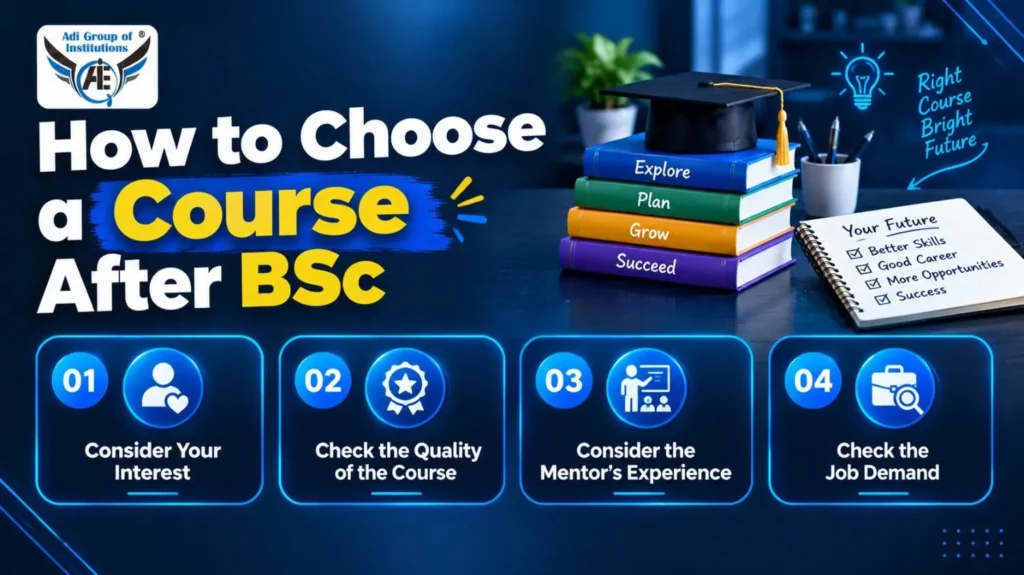
Choose a course that matches your interests and the type of work you enjoy. For example, if you like working with computers and solving technical problems, you can explore Cybersecurity or Data Analytics.
Check the syllabus, practical training, projects, internships, and placement support before enrolling. Choose a course that teaches relevant industry skills rather than focusing only on theory.
Check whether the trainers have relevant industry experience and practical knowledge of the subject. Experienced mentors can help you understand real workplace challenges and guide you in developing the skills employers expect.
Search for current job vacancies related to the course and check the qualifications, skills, and experience employers require. This helps you understand the career opportunities available, the entry-level salary range, and whether the course can support your long-term career goals.
Yes, you can choose a job-oriented course after BSc to develop practical skills for a specific industry. Before enrolling, check the course syllabus, hands-on training, internship opportunities, placement support, and eligibility requirements.
Cybersecurity and Data Science can offer good salary opportunities, particularly for candidates with strong technical skills and practical experience. However, your salary will depend on your qualifications, specialisation, employer, location, and experience.
Yes, some technical courses accept BSc graduates, depending on the programme and specialisation. However, certain roles in Robotics and Automation, BIM MEP Engineering, and QAQC Mechanical may require an engineering degree or diploma, so check the eligibility criteria before applying.
Start by identifying the subjects and activities you enjoy, then shortlist courses that match your interests and career goals. Compare course quality, trainer experience, practical training, job demand, and placement support before making your decision.
Choosing the right course after BSc is an important step towards building a career you enjoy. Hospital Administration, Cybersecurity, Robotics and Automation, Data Science and Data Analytics, BIM MEP Engineering, and QAQC Mechanical offer different career paths, so take time to understand what each field involves before making a decision. Compare the course syllabus, practical training, job opportunities, salary expectations, and eligibility requirements to find an option that suits your background and goals.
Remember, a course certificate alone does not guarantee a job. Focus on developing practical skills, gaining hands-on experience, and learning what employers expect in your chosen field. With the right training and consistent effort, you can use your BSc qualification as a starting point for a rewarding career.

Adi Institute is a leading educational institution in Kerala, committed to equipping learners with knowledge, skills, and innovation for the future. With experienced educators, modern facilities, and dedication to excellence, it offers a transformative learning experience that inspires growth, confidence, and career success.
Founded in 2014, Adi Group of Institutions offers job-oriented management and technical courses, equipping students with industry-relevant skills and providing 100% job assistance for successful career placement.
| [ninja_form id=2] |
WhatsApp us

