After MCom which course is best? The best courses after BCom depend on your career goals and interests. An MCom gives you strong subject knowledge. But most employers also want a skill or a professional qualification. This guide covers 7 courses for MCom graduates. For each one, you get eligibility, duration, fees, subjects, and fresher salary.
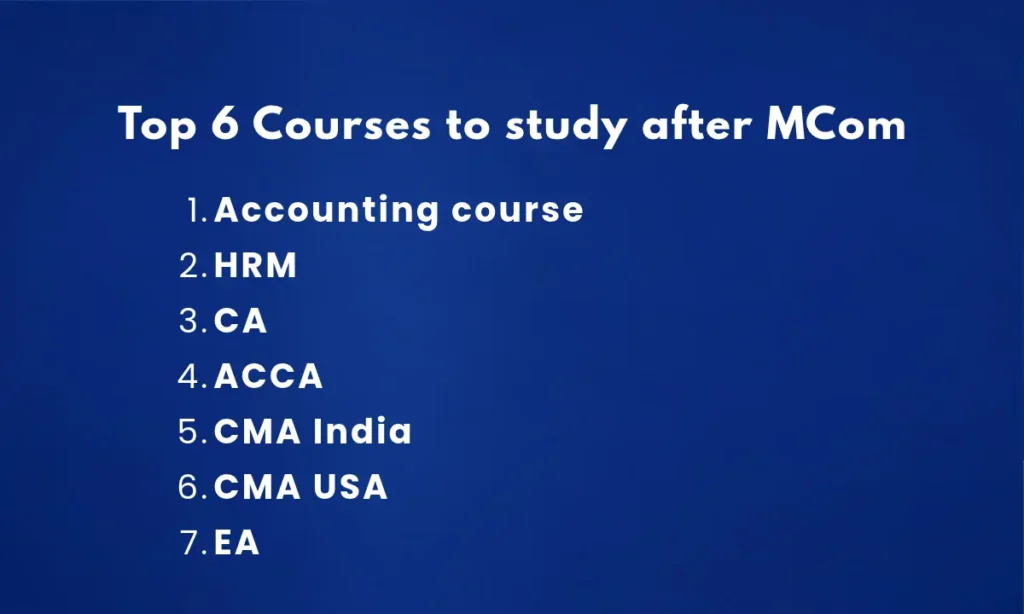
An accounting course teaches the daily work of an accounts team. You learn Tally, GST, TDS, income tax returns, and Excel. It is the quickest way to get a job after MCom.
Many MCom graduates know the theory but have never used accounting software. This course fills that gap.
HRM covers hiring, payroll, employee records, and training. Choose it if you like working with people more than with numbers. MCom plus HR is a useful mix for payroll and HR operations roles.
CA is India’s top accounting qualification. ICAI runs it. It leads to audit, tax, and finance jobs, or to your own practice.
ACCA is a global accountancy qualification from the UK. It is recognised in more than 180 countries. It suits MNC, Big 4, and Gulf jobs.
CMA India is run by the Institute of Cost Accountants of India (ICMAI). It focuses on costing, budgeting, and financial planning. Only a cost accountant can do a cost audit under the Companies Act, so manufacturing and public sector companies value it.
CMA USA is run by the Institute of Management Accountants (IMA) in the United States. It is a different course from CMA India. It covers budgeting, forecasting, and performance analysis, so it fits finance planning roles.
EA is a US tax license given by the IRS. It lets you represent US taxpayers before the IRS. Many US tax outsourcing firms in India hire EAs.
Do not start with the course. Start with the job. For audit and tax in India, choose CA. For costing and finance roles in India, choose CMA India. For MNC, Big 4 and Gulf jobs, choose ACCA or CMA USA. For US tax work, choose EA.
If you need income in six months, start with an accounting or HRM course. EA and CMA USA take about six to twelve months. ACCA takes about two years, and CA takes about four. Do not pick a long course if you cannot wait that long.
Short courses cost the least. CMA India is the cheapest professional qualification on this list. CA, ACCA, CMA USA, and EA cost more. Add coaching and retake costs to your plan, because many students need a second attempt.
CA needs years of steady study, and many students need extra attempts. If you want a shorter path, look at CMA USA, EA, or a short course. A long course that you quit halfway is a waste of money.
Read a few chapters. Watch a demo class. You will study this for years, so pick something you can stay interested in.
There is no single best course. CA is best for audit and tax in India. ACCA is best for MNC and Gulf roles. CMA USA is best for financial planning roles. An accounting or HRM course is best if you need a job within six months. Pick based on your goal, budget, and time.
Yes. If you scored at least 55% in your MCom, you can join CA through the direct entry route. You start at Intermediate and skip CA Foundation. ICAI gives MCom graduates no extra benefit over BCom graduates. If you scored below 55%, you can still start from CA Foundation.
CA usually gives the highest starting salary in India, but it takes the longest. ACCA and CMA USA also pay well, mainly in MNCs and the Gulf. Your pay depends more on your employer, city, and skills than on the course name.
An accounting course is the quickest. It takes 3 to 6 months, and you can apply for accountant and GST executive roles. EA and CMA USA take 6 to 12 months. CA and ACCA take much longer, but they lead to higher pay.
The best course after MCom is the one that matches your goal, budget and study time. Pick CA for audit and tax in India. Pick ACCA or CMA USA for MNC and Gulf jobs. Pick CMA India for costing roles. Pick EA for US tax. If you need a job soon, start with a short accounting or HRM course and add a professional qualification later.

Adi Institute is a leading educational institution in Kerala, committed to equipping learners with knowledge, skills, and innovation for the future. With experienced educators, modern facilities, and dedication to excellence, it offers a transformative learning experience that inspires growth, confidence, and career success.
Founded in 2014, Adi Group of Institutions offers job-oriented management and technical courses, equipping students with industry-relevant skills and providing 100% job assistance for successful career placement.
| [ninja_form id=2] |
WhatsApp us