Adi Group of Institutions

Category: Blog

Your blog category

  • What is Blogging in Digital Marketing & How to Start in 2027?

    What is Blogging in Digital Marketing & How to Start in 2027?

    What is Blogging in Digital Marketing & How to Start in 2027?

    Blogging_in_Digital_Marketing

    Before knowing about blogging, you need to know ‘’what is a blog?’’ A blog is written webpage content about a specific topic on a website. A blog is a tool to communicate with the target audience. The main purpose of a blog is to educate users about our service or product.

    Blogging is the process of writing blogs on a website. It is a method of communication about the business and service or product. A blog is structured web content that answers a specific intent. It includes Headings, Paragraphs, listicles, and CTA’s. The main goal of blogging in digital marketing is to attract the right audience through valuable, search-friendly content, build trust and authority with them, and turn that trust into leads, enrollments, or sales.

    How Blogging Helps in Digital Marketing?
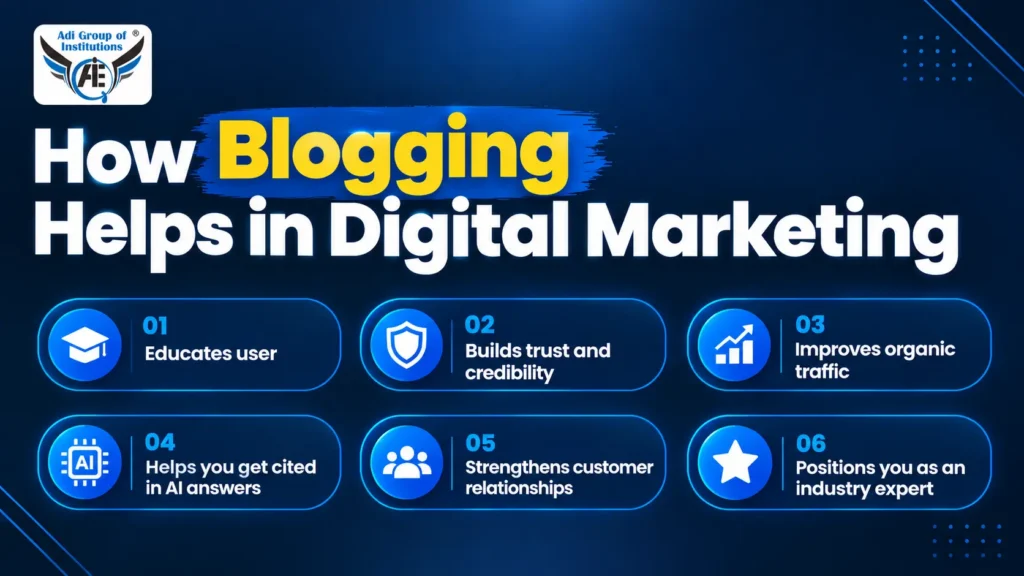
    1. Educates users

    Most buyers research online before they make a decision, and a blog lets you meet them at that exact moment. When you explain concepts, compare options, and answer common questions clearly, you help readers move from confusion to confidence. Educational posts also shorten the sales cycle, because informed users ask better questions and need less convincing. The more useful your answers are, the more likely people are to come back to your site.

    2. Builds trust and credibility

    People trust brands that share real knowledge without pushing a hard sell. Publishing accurate, well-researched, and consistent content shows that your business understands its subject and stands behind what it says. Adding author names, real examples, and updated information strengthens E-E-A-T signals, which matter to both readers and search engines. Over time, this trust makes users more comfortable choosing you over a competitor they have never heard from.

    3. Improves organic traffic

    Every blog post is a new page that can rank for a keyword your audience is already searching. By targeting the right search intent and linking related posts together, you can build topical authority and bring in free, long-term traffic. Unlike paid ads, a well-optimised blog post keeps attracting visitors months or even years after it is published. Refreshing older posts regularly helps them hold their rankings and keeps that traffic steady.

    4. Helps you get cited in AI answers

    AI tools like ChatGPT, Perplexity, and Google AI Overviews pull their answers from clear, trustworthy, well-structured content. Blog posts that give direct answers, use simple headings, include FAQs, and cover a topic in depth are far more likely to be picked up and cited. Being mentioned in these answers puts your brand in front of users who may never scroll through traditional search results. As more people rely on AI for research, this visibility becomes a real competitive advantage.

    5. Strengthens customer relationships

    A blog keeps the conversation going long after a user has visited your site or become a customer. You can use it to solve common problems, share updates, and answer the questions your audience keeps asking. Helpful posts can also be shared through email, social media, and WhatsApp, which keeps your brand present in a natural way. When customers feel supported and not just sold to, they stay loyal and are more likely to recommend you to others.

    6. Positions you as an industry expert

    Consistent, high-quality blogging shows that you understand your field deeply and keep up with changes in it. Sharing original insights, practical tips, and real experience sets you apart from brands that only repeat generic information. Over time, other websites, journalists, and professionals begin to reference your content, which builds authority and earns valuable backlinks. This expert reputation makes every other marketing channel work better, from search rankings to sales conversations.

    Types of Blogging
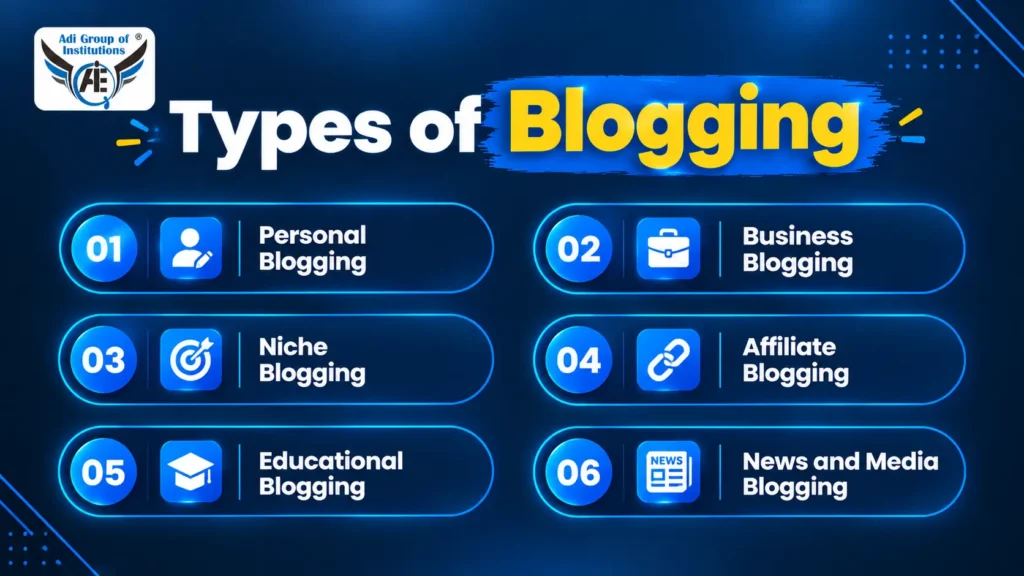
    1. Personal Blogging

    A personal blog is built around your own experiences, opinions, and daily learning. Writers use it to share stories, document a journey, or build an online presence from scratch. It is the easiest type to start because you write about what you already know. Over time, a strong personal blog can grow into a personal brand that opens doors to freelancing, jobs, and collaborations.

    2. Business Blogging

    A business blog is run by a company to support its marketing goals. It answers customer questions, explains products and services, and attracts potential buyers through search. Done well, it brings in organic traffic, builds trust, and supports leads and sales. This is the most useful type for institutes, agencies, startups, and service providers who want steady, low-cost visibility.

    3. Niche Blogging

    A niche blog focuses on one specific topic, such as digital marketing, personal finance, or career guidance. Because the content stays focused, search engines and readers see you as a specialist in that area. This builds topical authority faster than a blog that covers many unrelated subjects. If you want to rank well and become a trusted source, picking a clear niche is one of the smartest decisions you can make.

    4. Affiliate Blogging

    Affiliate blogs earn money by recommending products or services and receiving a commission when readers buy through their links. Common content includes product reviews, comparisons, and “best of” lists. The key to success is honesty, because readers quickly lose trust if every post feels like a sales pitch. Always disclose your affiliate links and recommend only what you genuinely believe is useful.

    5. Educational Blogging

    Educational blogs teach readers new skills through guides, tutorials, how-to articles, and explainers. They suit trainers, teachers, institutes, and anyone who enjoys breaking complex topics into simple steps. These posts often perform very well in search and are frequently picked up in featured snippets and AI answers, since they give clear, direct information. They also help readers trust you before they enrol, subscribe, or buy.

    6. News and Media Blogging

    News blogs publish timely updates, trends, and analysis about a specific industry or topic. Speed and accuracy matter most here, since readers come for fresh information they can rely on. This type needs a regular publishing schedule and strong fact-checking. When done consistently, it can build a loyal audience and strong authority in your field

    How to Start Blogging in 2027 ?

    Blogging in 2027 rewards honest, experience-based content. Readers have more choices, and search engines and AI answer engines now look for trustworthy sources. Here are 8 practical tips to help you start the right way.

    1. Choose a Clear Niche and Know Your Audience

    Pick one topic where you have real knowledge or genuine interest, such as digital marketing, finance, or career guidance. Then decide exactly who you are writing for, because a student, a working professional, and a business owner all search differently. Use Google autocomplete, People Also Ask, Reddit, and Quora to find the real questions your audience is asking. A focused niche builds topical authority faster than a blog that covers everything.

    2. Set a Clear Goal for Your Blog

    Decide why you are blogging. It could be to attract customers, build a personal brand, earn through affiliate links, or support a business. Your goal shapes your topics, your tone, and the calls to action you use. A blog without a goal often loses direction within a few months.

    3. Pick the Right Platform and Domain

    WordPress is still the best option for long-term growth, as it gives you full control over design, speed, and SEO. Choose a short, easy-to-remember domain name that fits your niche, and avoid hyphens and confusing spellings. Invest in reliable hosting, since a slow website hurts both rankings and user experience. Owning your domain is better than building only on free platforms.

    4. Do Keyword Research Before You Write

    Keyword research shows what people are actually searching for. Free tools like Google Search Console and Google Keyword Planner are enough to begin with. Start with low-competition, long-tail keywords such as “how to start a blog for students” instead of broad terms like “blogging”. These are easier to rank for and bring more relevant readers.

    5. Write for People First and Show Real Experience

    Answer the main question early, use simple language, and add real examples, practical steps, and lessons from your own work. Add an author bio, cite reliable sources, and keep your About page clear to strengthen E-E-A-T. Use AI tools only as an assistant for brainstorming and outlining, and always add your own insights and fact-checking. Your genuine experience is what separates your blog from generic AI-written content.

    6. Structure Your Posts for Search and AI Answers

    Use one clear H1, logical H2 and H3 headings, short paragraphs, and bullet points where they help. Give a direct answer near the top and include an FAQ section for common questions. This structure makes it easier for Google featured snippets, AI Overviews, ChatGPT, and Perplexity to understand and cite your content. It also helps busy mobile readers scan your post quickly.

    7. Optimise for Mobile Speed and Publish Consistently

    Most readers browse on mobile, often on average-speed connections, so use a lightweight theme, compress images to WebP, and avoid heavy plugins. Then build a simple content calendar and publish on a steady schedule, even if it is just one or two quality posts a week. Consistency builds reader trust and tells search engines your site is active. A fast, regularly updated blog keeps visitors coming back.

    8. Promote Your Content and Track Your Results

    Share your posts on LinkedIn, X, Reddit, Quora, and WhatsApp communities, and repurpose them into short videos or social posts. Start an email list early, because it is an audience you own regardless of algorithm changes. Set up Google Search Console and GA4 from day one to see which posts get impressions, clicks, and engagement. Use that data to improve older posts and choose better topics going forward.

    Frequently Asked Questions

    Start by choosing one niche and knowing who you are writing for. Then set a clear goal, pick a platform like WordPress with a simple domain name, and do keyword research using free tools like Google Search Console and Google Keyword Planner. After that, publish your first post and share it on LinkedIn, Quora, or WhatsApp communities.

    Most new blogs take a few months of regular publishing before they see steady traffic. The timeline depends on your niche, competition, and content quality. Targeting low-competition long-tail keywords, publishing consistently, and updating older posts can help you see results faster.

    Yes, you can. Blogging and SEO do not need coding or a technical degree. If you can research a topic, write in simple language, and follow basic SEO steps, you can learn the rest with practice. A structured digital marketing course can help you learn faster with expert guidance and real projects.

    Conclusion

    Blogging in 2027 is not about publishing more posts; it is about genuinely useful publishing posts. When you choose a clear niche, set a goal, research keywords, share real experience, and structure your content for both readers and AI answer engines, your blog slowly builds trust and topical authority. Results will not come overnight, and most blogs need a few months of consistent work before the traffic shows, so keep tracking your progress in Google Search Console and GA4, and keep improving your older posts. Joining a digital marketing course in Kerala can help you build these skills faster with expert guidance and real projects.
    Don’t wait for the perfect idea or the perfect setup. Pick one question your audience is asking, write the best answer you can, publish it, learn from the data, and repeat. Start your first blog post today.

    For-Admission
    Adi Group of Institutions

    Adi Institute is a leading educational institution in Kerala, committed to equipping learners with knowledge, skills, and innovation for the future. With experienced educators, modern facilities, and dedication to excellence, it offers a transformative learning experience that inspires growth, confidence, and career success.
    Related Posts

  • What Is Cybersecurity? Meaning, Importance, and Types

    What Is Cybersecurity? Meaning, Importance, and Types

    What Is Cybersecurity? Meaning, Importance, and Types

    what-is-cybersecurity

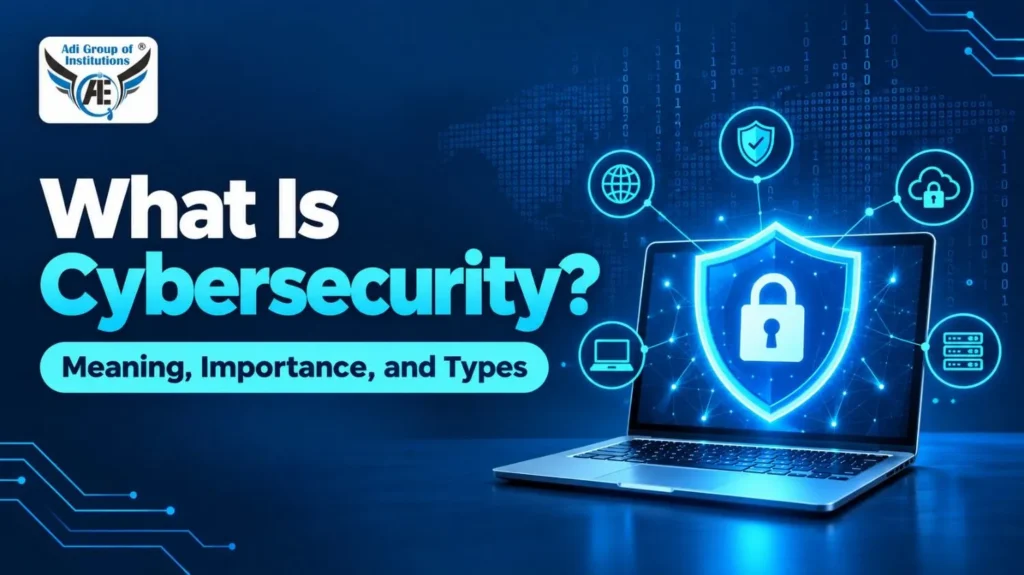
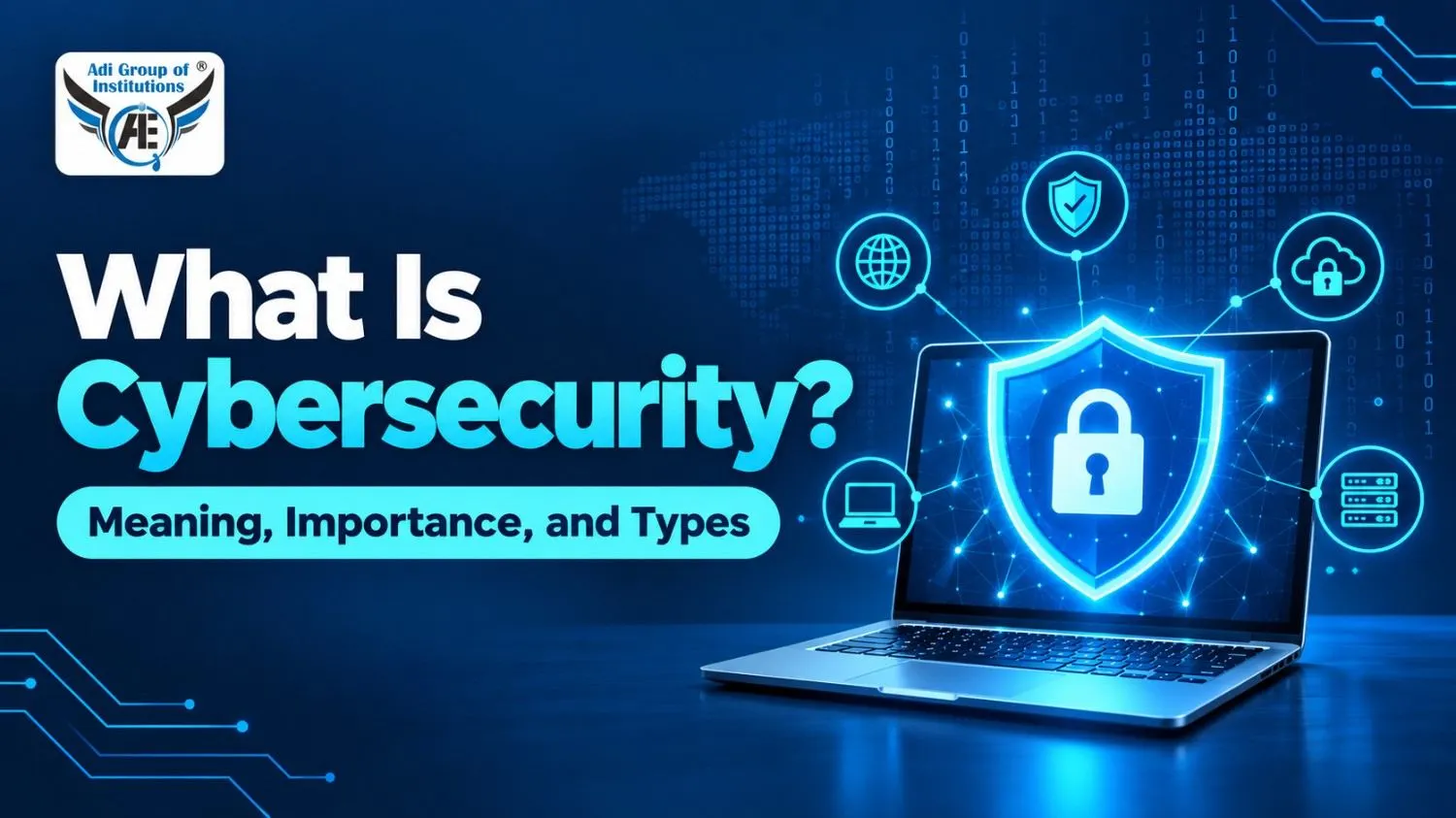
    If you use the internet, you need to understand cybersecurity. Cybersecurity is the practice of protecting computers, networks, applications, devices, and digital information from unauthorized access, attacks, damage, or disruption. In simple words, it is how we keep our digital life safe from hackers and online threats.

    In this guide, you will learn what is cybersecurity, why it matters, the different types of cybersecurity, and the most common threats you should watch out for. By the end, you will also understand why cybersecurity is one of the fastest-growing career fields for students in Kerala and the Gulf job market.

    What Is Cybersecurity?

    Cybersecurity means protecting your digital devices, accounts, and data from people who try to steal, damage, or misuse them. This includes your laptop, your phone, your college Wi-Fi network, and even the apps you use every day.

    Think of it like locking your house at night. You lock doors and windows to keep thieves out. Cybersecurity does the same thing, but for your digital world — your passwords, your files, your bank details, and your online identity.

    Importance of Cybersecurity

    Cybersecurity matters because almost everything we do today happens online — studying, banking, shopping, and even applying for jobs abroad. If your data is not protected, you risk losing money, personal information, or access to important accounts. This rising demand is why diploma courses in Kerala now treat cybersecurity as a must-have skill for students entering the digital job market.

    Here is why cybersecurity is important for students, professionals, and businesses alike:

    • It protects your personal information, like Aadhaar details, bank logins, and passwords, from being stolen.
    • It keeps businesses running by preventing costly data breaches and downtime.
    • It builds trust between companies and their customers, especially for banks, hospitals, and online stores.
    • It protects national infrastructure, like power grids and government systems, from large-scale attacks.
    • It creates strong career opportunities, since almost every industry now needs cybersecurity professionals.

    Types of Cybersecurity

    types-of-cybersecurity

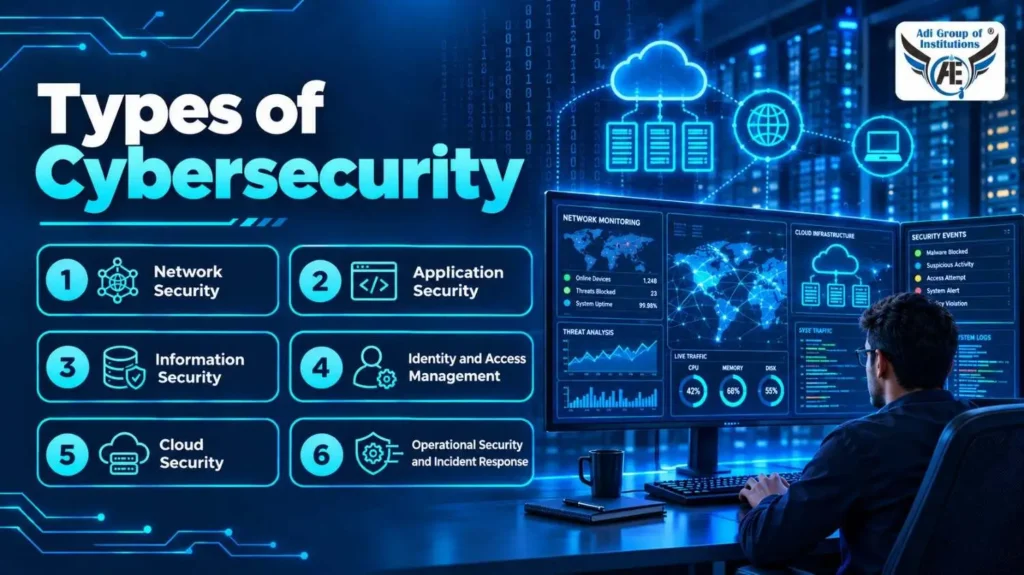
    1. Network Security

    Network security protects the connection between devices, such as your college Wi-Fi or office network, from unauthorized access and attacks.

    2. Application Security

    This focuses on finding and fixing weaknesses in software and apps before hackers can exploit them. It is important during app and website development.

    3. Information (Data) Security

    Data security protects sensitive information, like customer records or financial data, from being accessed, changed, or leaked without permission.

    4. Identity and Access Management

    Identity and Access Management controls who can access which systems and data. It ensures only the right people can log in to sensitive accounts, using tools like multi-factor authentication.

    5. Cloud Security

    As more companies store data on platforms like AWS or Google Cloud, cloud security protects that data and the cloud infrastructure itself.

    5. Operational Security and Incident Response

    This area monitors systems for unusual activity and responds quickly when a security incident happens, limiting damage and restoring normal operations.

    Frequently Asked Questions

    Students use email, social media, and online banking daily, making them common targets for phishing and password theft. Learning cybersecurity basics helps protect personal data and opens up strong career opportunities.

    The main types are network security, application security, information security, identity and access management, cloud security, and operational security or incident response. Each protects a different part of a digital system.

    Job-oriented diploma courses in cybersecurity are designed for Plus Two, B.Com, and BBA graduates, helping them enter the field without needing a technical degree first.

    Conclusion

    Cybersecurity protects the digital world we depend on every day, from your college login to a company’s entire customer database. Understanding its meaning, importance, types, and common threats is the first step toward staying safe online, and for many students, the first step toward a rewarding career.

    If you are looking for the best cybersecurity course in Kerala, choose one that covers network security, ethical hacking basics, and hands-on lab practice, not just theory.

    For-Admission
    Adi Group of Institutions

    Adi Institute is a leading educational institution in Kerala, committed to equipping learners with knowledge, skills, and innovation for the future. With experienced educators, modern facilities, and dedication to excellence, it offers a transformative learning experience that inspires growth, confidence, and career success.
    Related Posts

  • After BCA Which Course is Best?

    After BCA Which Course is Best?

    After BCA Which Course is Best?

    After BCA Which Course Is Best

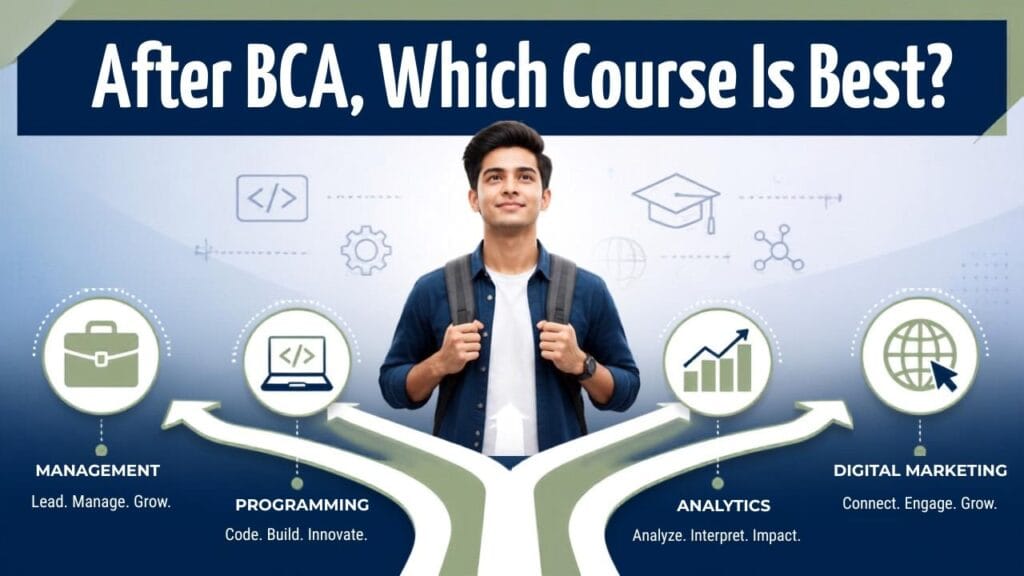
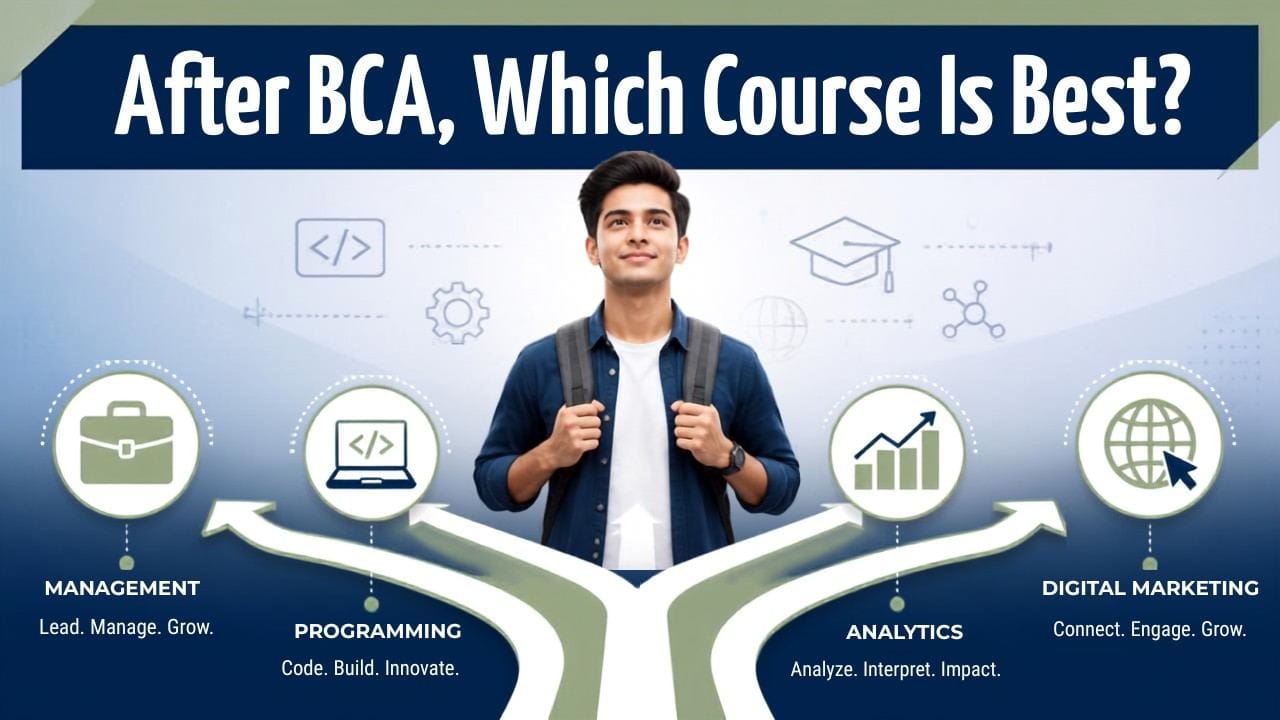
    After BCA which course is best? You have completed BCA and having doubt which course is best after BCA; the answer is simple: there is no single course is best after BCA. It depends on your skills and interests.
    There are two options. If you are really interested in coding, software, and development, you can choose coding and technical courses related to BCA.
    If you don’t have an interest in continuing in the coding and software field, you can choose another non-coding field. In this blog, you can see the courses that are related and non-related to BCA.

    Importance of short-term courses after BCA

    A BCA degree gives you the basics, but it doesn’t always give you what a company actually looks for on day one. This is where short-term diploma courses make the real difference. Employers today care more about what you can do than what your marksheet says. A recruiter would rather hire someone who can build a working project than someone who has only studied the theory behind it. That’s why skills like data analytics, digital marketing, or cyber security through a focused short-term course can open doors that a degree alone can’t. Companies want people who can start contributing quickly, not people who need six months of training before they’re useful. So after BCA, picking up one or two practical, job-ready skills isn’t optional anymore — it’s what actually gets you hired.

    Top Courses After BCA

    Top Courses to Choose After BCA

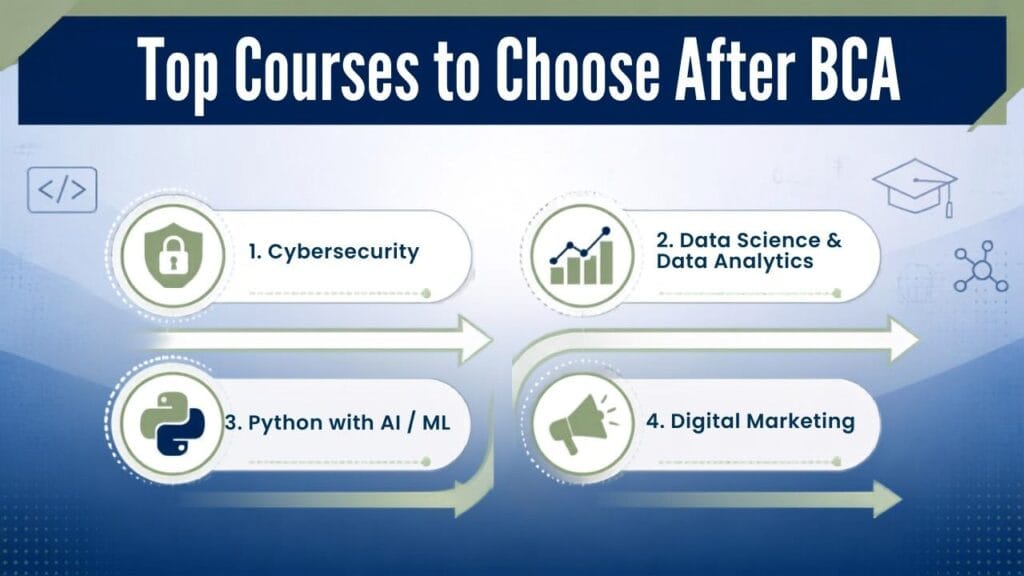
    1. Cyber Security with AI

    If you are searching, after BCA which course is best? Cybersecurity is one of the best courses after BCA. In this course, you will study hacking and how to defend against hacking. You already studied the basics in BCA, so if you have interest in network security and problem solving, cyber security is a perfect course. The cybersecurity market is growing fast as more businesses move online

    After a cybersecurity course, you can work as a penetration tester, cybersecurity analyst, network analyst, SOC Analyst

    Average salary is 4 – 6 LPA for cybersecurity freshers in India

    2. Data Science & Data Analytics

    After BCA which course is best? A lot of BCA graduates ask this, and data science is one of the strongest answers. It teaches you how to find useful patterns in data and use them to make smart decisions. You learn Python, statistics, machine learning, data visualization, and tools like SQL and Excel. You also work on real projects, like predicting sales trends or studying customer behaviour, so you build actual skills, not just theory.

    Once you finish the course, you can apply for roles like Data Analyst, Data Scientist, Machine Learning Engineer, Business Intelligence Analyst, or Data Engineer. Freshers in India usually start between ₹3.5 LPA and ₹6 LPA, depending on the company, city, and how skilled you are. Build strong project experience during the course, and you can often negotiate a higher starting salary. The data science market is projected to grow from around $117.70 billion in 2025 to $589.40 billion by 2035, at a CAGR of 17.85% according to Market Research Future.

    3. Python with AI / ML

    If you enjoy coding and want to build things, Python with AI is worth a serious look. This course takes you through Python from the basics all the way to advanced concepts, with a strong focus on AI applications.

    Once you complete it, you can explore roles like Python Developer, AI/ML Engineer, Data Analyst, or Automation Engineer. Companies across IT, finance, healthcare, and e-commerce are hiring skilled Python and AI professionals right now. As a fresher in India, you can expect a starting salary between ₹3 LPA and ₹6 LPA, depending on your skills and location.

    4. Digital Marketing

    Another course to do after BCA is digital marketing. It’s marketing done through digital channels — websites, social media, search engines, and email — instead of traditional print or TV. According to Research and Markets, the digital marketing market is projected to reach $1,200 billion by 2034, so demand for skilled people in this field is only going to grow. If you enjoy marketing and want to stay close to IT, this course is a good fit.

    After completing it, you can work as a Digital Marketing Executive, SEO Analyst, or Social Media Executive. Freshers in India typically start between ₹3 LPA and ₹5 LPA. Beyond a regular job, digital marketing also opens up many freelancing opportunities, since businesses of every size need this skill.

    How to Choose a Course After BCA

    How to Choose a Course After BCA

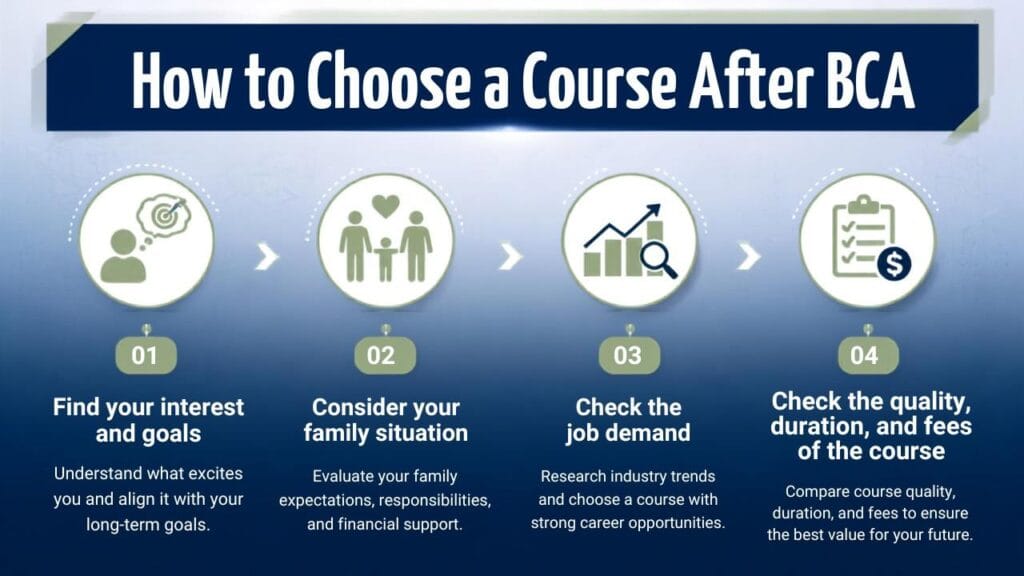
    1. Find your interest and goals

    Only select a course that you are actually interested in. A course that matches your interest is easier to finish, and you can do the job happily. Also, set goals to achieve.

    2. Consider your family situation

    If you want to support your family within 1 year or a few months, a short-term job-oriented course is the best option.

    3. Check the job demand

    While selecting a course, check the future job opportunities in the field. With the increase of AI technology, the job market has changed a lot. So select a course where there are enough job opportunities.

    4. Check the quality, duration, and fees of the course

    Always select a quality, updated course and make sure the fees is ok for you. Select a course that makes you job-ready with practical training.

    Frequently Asked Questions

    There is no single course that is best after BCA. If you want to continue coding and software, choose data science and cybersecurity. If you want to change your career into a creative IT field, you can choose digital marketing.

    If you’re aiming for a technical, research-heavy career and can afford two more years, MCA makes sense. If you want quicker entry into the job market with skills companies are actually hiring for right now, a job-oriented course gets you there faster.

    The best job after BCA depends on your strengths. If you’re good at coding, aim for software development; if you like data and numbers, data analyst roles are in high demand.

    Conclusion

    There’s no single “best” course after BCA; it depends on what you enjoy and where you want to go next. If you like coding, data science or Python with AI will take your skills further. If networks and problem-solving interest you, cyber security is a strong choice. And if you’d rather move into a creative, less technical field, digital marketing gives you a good start with faster entry into jobs.

    For-Admission
    Adi Group of Institutions

    Adi Institute is a leading educational institution in Kerala, committed to equipping learners with knowledge, skills, and innovation for the future. With experienced educators, modern facilities, and dedication to excellence, it offers a transformative learning experience that inspires growth, confidence, and career success.
    Related Posts

  • Top 5 Courses After BA: Which One Should You Choose?

    Top 5 Courses After BA: Which One Should You Choose?

    Top 5 Courses After BA: Which One Should You Choose?

    Courses after BA

    Are you confused about what to do after BA? There are a lot of courses available after BA, but not every course helps you get a job. You can choose traditional courses like MA, LLB… If you have strong interest and career goal. But if you don’t know what to study, in this blog, you will learn about the top 5 courses after BA.

    After BA Which Course is Best?

    There is no specific course is best after BA. The best course after BA depends on your interests and career goals. So the first thing is to understand your interests and career goals. There are traditional long-term courses and short-term courses available. If you need a quick job and cost-effective study, choosing a short-term course is best. Below you can see the 5 courses you can choose after BA.

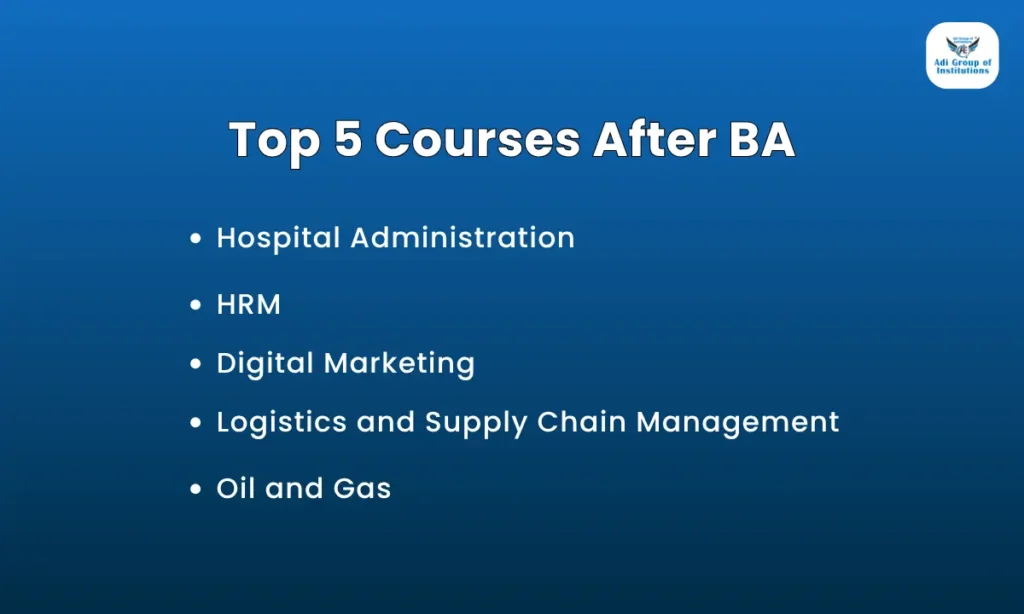
    Top 5 Courses After BA

    Top Courses after BA

    1. Hospital Administration

    If you want to work in hospitals without a medical background, hospital administration is the best course after BA. Hospital Administration is one of the best courses after BA. Hospital administration means managing day-to-day operations, including office administration, coordination, and patient records. If you are interested in people communication and managing things, hospital administration is the best course after BA.

    Course eligibility

    Plus Two – (Any stream)
    Degree – (Any field)

    Career Options – You can work as a hospital administrator, Medical Records Executive, front office executive, and Patient Relationship Officer

    Average salary – ₹3–5 LPA for freshers

    2. HRM

    HR management is another best course you can study after BA. If you like communication and coordination with people, HR career is the best course. HR management is the process of hiring the right employees and helping them grow, stay motivated, and do their best work. HR makes sure the employees work happily. It involves consistent employee communication.

    Course eligibility

    Plus Two – (Any stream)

    Degree – (Any field)

    Career Options – After HR course, you can work as HR executive, Recruitment Coordinator, Payroll Executive, and HR Administrator

    Average salary – ₹2.5–7 LPA for freshers

    3. Digital Marketing

    In courses after BA, if you want to enter the IT field after BA digital marketing is the best option. Digital marketing means marketing through digital media like Google, AI search engines, Instagram, and other social platforms. Skills are the most important in digital marketing. If you have interest in business, marketing, and communication with a creative mind, digital marketing is a perfect course for you. You can also become a freelancer and work from anywhere.

    Course eligibility

    Plus Two – (Any stream)

    Degree – (Any field)

    Career Options – After digital marketing course, you can work as digital marketing executive, social media executive, and SEO Analyst

    Average Salary – ₹3–5 LPA for freshers

    4. Logistics and Supply Chain Management

    Logistics is one of the best courses after BA if you want a job-ready career fast. A career in logistics means managing how goods move from one place to another, on time and without damage. This field is a smart choice after BA because it does not need a technical background, and companies hire freshers with the right training. India’s logistics sector is growing quickly due to e-commerce and export growth, which means more job openings every year. Many BA graduates choose a logistics course in Kerala because it offers hands-on training, placement support, and quick entry into a well-paying career.

    Course eligibility

    Plus Two – (Any stream)

    Degree – (Any field)

    Career Options – You can work as a Logistics Coordinator, Warehouse Executive, and Procurement Assistant after the logistics course.

    Average salary – ₹3–6 LPA for freshers

    5. Oil and Gas

    Oil and gas is a great career option if you are looking for courses after BA. This field deals with finding, processing, and supplying oil and gas to homes, industries, and vehicles. As a BA graduate, you can join this industry in roles like plant operations, safety management, supply chain, or logistics. You do not need an engineering background, this course is open to graduates from any stream. Many students choose this path because it leads to well-paying jobs in Gulf countries like the UAE, Qatar, and Saudi Arabia.

    Course eligibility

    Plus Two – (Any stream)

    Degree – (Any field)

    Career Options – You can work as a Quality Inspector, Health and Safety, and Maintenance Technician

    Average salary – ₹3–5 LPA for freshers

    How to Choose a Course after BA?

    1. Find your interest & career goal

    Before picking any courses after BA, get clear on what kind of work you actually want to do. If you enjoy people-facing roles, HR or hospital administration might suit you. If you like numbers and structure, accounting or logistics could be a better fit. Choosing based on what’s “in demand” without checking your own interest often leads to dropouts and regret later.

    2. Make sure the job is in demand

    Before joining the course, make sure the job after the course is in demand. With the advancements of AI, the nature of jobs in some fields is changing. So double

    3. Choose quality training

    To get a job, you need job-ready skills. And to build job-ready skills, you need the right training. Not every course teaches you what companies actually look for on the job. So before you enrol anywhere, check the trainers’ real work experience, how much hands-on practice you get, and whether the syllabus matches what employers expect today.

    4. Understand the Course duration and fees

    Before you join any course, check how long it takes and how much it actually costs. Compare the total cost with the course duration, and see if that time and money fit your budget and career timeline.

    Frequently Asked Questions

    There is no specific best course after BA. The best course depends on your interest and situation. If you enjoy digital work, try digital marketing or data science. If you prefer structured, detail-oriented work, accounting or logistics could suit you better. Pick a course that matches your strengths and career goals, not just what others are choosing.

    It depends on your career goal. If you want to enter the job market quickly, a short diploma course is more practical. If you’re aiming for research, teaching, or a specialised field, higher studies like an MA or MBA may be better for long-term growth.

    Courses like digital marketing, data science, and logistics currently have strong job demand in India and the Gulf. These fields are growing fast and hiring regularly. The “best” option still depends on your skills and interests, so choose one where you can genuinely perform well.

    Conclusion

    These are the best courses after BA. You will get a higher salary than the average salary according to your skills and the results you made. Always choose a course according to your interest; otherwise, you won’t have any interest in working. Thoroughly research the course before selecting.

    For-Admission
    Adi Group of Institutions

    Adi Institute is a leading educational institution in Kerala, committed to equipping learners with knowledge, skills, and innovation for the future. With experienced educators, modern facilities, and dedication to excellence, it offers a transformative learning experience that inspires growth, confidence, and career success.
    Related Posts

  • After BBA Which Course is Best?

    After BBA Which Course is Best?

    After BBA Which Course is Best?

    after-bba-which-course-is-best

    Have you completed BBA? If yes, what are the skills did you gain to do a job? The majority of the students have no answer. Because our BBA degree does not provide any practical job skills needed for a job. So you have to gain practical job-oriented skills after BBA. If you have any confusion, after BBA which course is best? Here are the top short-term courses after BBA. There are a lot of courses available after BBA. Choose the right course based on your interests and skills.

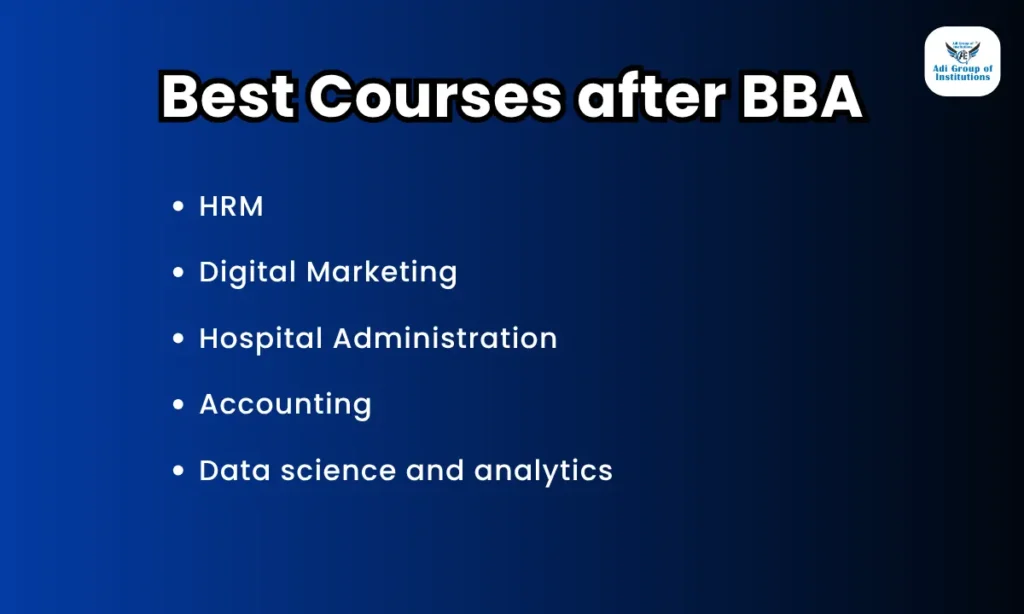
    Best Courses after BBA

    best-courses-after-bba

    1. HRM

    HR management is the best course to study after BBA. You have already studied theoretical knowledge of administration and management. So if you have an interest in employee management and administration, you can choose the HRM course. In this course, you will practically study employee management, performance analysis, payroll systems, and hr softwares.
    According to EY’s CHRO 2030 market research, 85% of employers said strategic hr will become very important to business success. So every company needs hr professionals. If you are good at communication and people coordination, HRM is the perfect course for you.

    Course duration

    6 Months & 1 Year

    Career Roles – Digital Marketing Executive, SEO Analyst, Social Media Executive

    Average salary – 3 – 5 LPA

    2. Digital Marketing

    If you are searching after BBA which course is best? Digital marketing is another best course you can study after BBA. This course teaches you SEO, social media marketing, Google Ads, email marketing, and content strategy. You have already studied business and marketing theoretically in BBA. So it will help you study digital marketing.

    After the course, you can enter a job, or you can work as a freelancer if you are confident. If you are interested in business and technology, studying digital marketing is the best option.

    Course duration

    6 Months & 1 Year

    Career Roles – Digital Marketing Executive, SEO Analyst, Social Media Executive

    Average salary – 3 – 5 LPA

    3. Hospital Administration

    After BBA which course is best? Hospital Administration is one of the best courses to study after BBA. In this course, you will study day-to-day hospital operations, patient services, medical records management, and healthcare finance. You have already studied the theory of management, so you can easily study the course. 

    The scope of hospital administration is growing year by year. According to IBEF, India’s healthcare sector is expected to add over 6.3 million more jobs by 2030. Hospital administration is the best course to enter healthcare without any medical background.

    Course duration

    6 Months & 1 Year

    Career Roles – Hospital administrator, Patient Relations Manager, Insurance Coordinator, Medical Records Executive, and Operations Executive

    Average salary – 3 – 5 LPA

    4. Accounting

    In short-term courses after BBA, Accounting is the most stable career path. Every company, whether it is small or big, needs accounting employees. In BBA, you have already studied accounting and finance theory. So, in the course, you will study practically from the basics of accounting to advanced software.

    According to the US Bureau of Labor Statistics, jobs for accountants and auditors are expected to grow 5% from 2024 to 2034, faster than most other jobs. If you are interested in working with money, maths, and numbers, accounting course is the best option after BBA.

    Course duration

    6 Months & 1 Year

    Career Roles – Accountant, Tax Accountant, Audit Assistant, GST Executive, Finance Executive, and Financial Analyst

    Average salary – 2 – 5 LPA

    5. Data science and analytics

    If you are asking after BBA which course is best? Data science is another best course you can study after BBA. It teaches you how to work with data, numbers, and business insights. You will learn Python, statistics, machine learning, and data visualization.

    According to Research and Markets, the global data science market will grow by $375.6 billion between 2025 and 2030. If you are interested in business analytics and technology, you can study the course without any coding knowledge.

    Course duration

    6 Months & 1 Year

    Average salary – Career Roles – Data Analyst, Business Intelligence Analyst, Data Engineer, and Data Visualisation Specialist

    Average salary – 3 LPA to 5 LPA

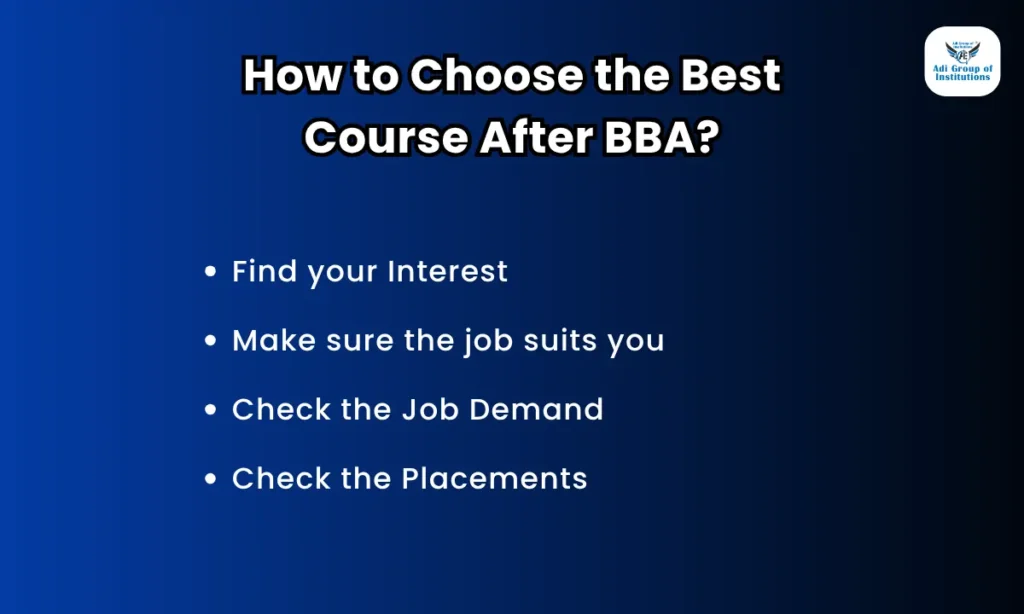
    How to Choose the Best Course After BBA?

    1. Find your Interest

    The first thing to consider is your interest in the field. The simple method to find interest in a field is to imagine whether you would work in any field without getting paid. If you continue the work even without a salary, that is your interested field.

    2. Make sure the job suits you

    Everyone can study these courses; check whether the job after the course suits you. Understand the nature of the job and the skills needed for the job.

    3. Check the Job Demand

    Before selecting the course, check the job demand yourself. You can check the job portals for your career roles after the course. If enough job vacancies are available, that job has demand.

    4. Check the Placements

    Before joining an institute, check the placements and quality of the training provided by the institute. Choose a good institute that provides practical, job-oriented training.

    Frequently Asked Questions

    No single course is best after BBA; the best course depends on your interest and skills. These 5 courses are the most suitable courses to study after BBA.

    If you want a quick job at an affordable expense, a short-term course is best, and if you need deep knowledge in the field and you have enough time to support your family, you can study long-term courses.

    In these courses, digital marketing has the highest earning potential. If you are good at digital marketing, you can earn more money by freelancing than in a 9-to-5 job.

    Conclusion

    These are the best courses after BBA. The business, finance, and management knowledge studied in BBA helps you study these courses and gain practical skills. Choosing the right course is very important in your life. The right course depends on your interests and skills. So take time and compare options before enrolling in a course. 

    Still have doubts about after BBA which course is best? Contact Adi Institute, which provides the best job-oriented training courses in Kerala.

    For-Admission
    Adi Group of Institutions

    Adi Institute is a leading educational institution in Kerala, committed to equipping learners with knowledge, skills, and innovation for the future. With experienced educators, modern facilities, and dedication to excellence, it offers a transformative learning experience that inspires growth, confidence, and career success.
    Related Posts

  • Best Computer Courses For Job in 2026

    Best Computer Courses For Job in 2026

    Best Computer Courses For Job in 2026

    best-computer-courses-for-job

    Do you want to work simply sitting in a chair in front of a computer? For that, there are a lot of computer courses available now. But after the emergence of artificial intelligence, studying any computer courses can’t get you a job. Study the latest courses integrating AI. So choose the best computer courses for a job.

     
    In this guide, you will see the best computer courses for job, including cybersecurity, data science, digital marketing, accounting, Python with AI, and what jobs you can get after them, and how to pick the right one for you.

    Why Computer Courses Matter More Than Degrees Today?

    Companies value practical skills more than traditional degrees. After completing computer courses, you will get job-ready skills.
    This is why short, focused computer courses have become so popular. They teach exactly what a job needs, in a fraction of the time a full degree takes. You finish faster, spend less money, and start earning sooner. So choose the career oriented computer courses from below.

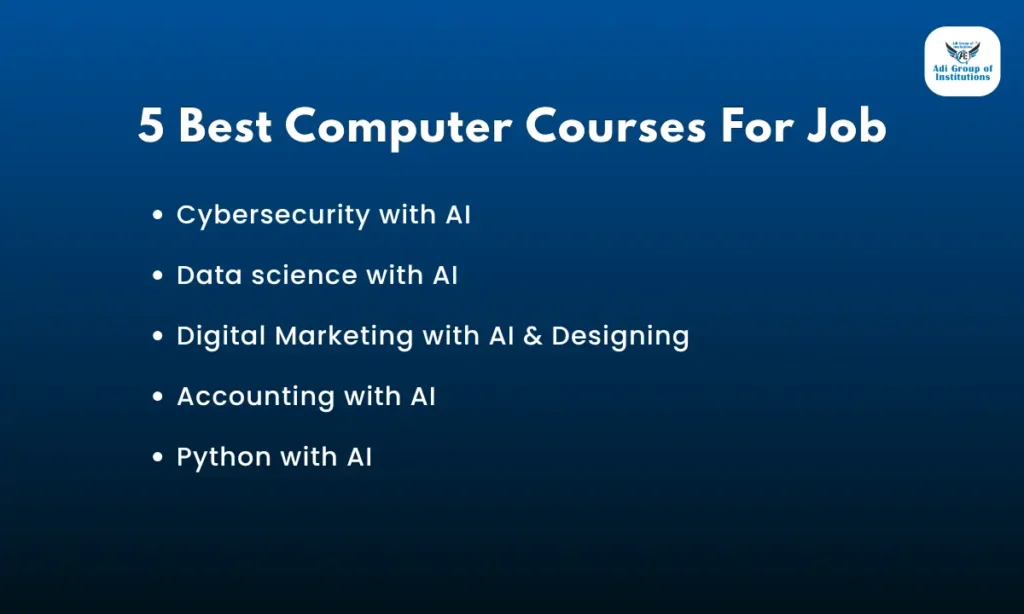
    5 Best Computer Courses For Job

    computer-courses -for-job

    1. Cybersecurity with AI

    Cybersecurity is one of the high-paying computer courses now. According to the World Economic Forum, the demand for cybersecurity skills and network is projected to be the second fastest growing field globally. In cybersecurity, you will learn to protect computers and network systems from hacking.

    After the cybersecurity course, you can work as a penetration tester, cybersecurity analyst, network analyst, SOC Analyst, etc

    Course duration

    6 Months & 1 Year

    Average salary – 4 LPA to 6 LPA

    2. Data science with AI

    A data science course teaches you how to find useful patterns in data and use them to make smart decisions. In this course, you learn Python programming, statistics, machine learning, data visualization, and tools like SQL and Excel. You also work on real projects, such as predicting sales trends or analyzing customer behaviour, so you build practical skills, not just theory.

    After finishing the course, you can apply for roles like Data Analyst, Data Scientist, Machine Learning Engineer, Business Intelligence Analyst, or Data Engineer. If you build strong project experience during the course, you can often negotiate a higher starting salary.

    Course duration

    6 Months & 1 Year

    Average salary – 4 LPA to 5 LPA

    3. Digital Marketing with AI & Designing

    Digital marketing is one of the best computer courses for job right now. Digital marketing is the marketing done through digital channels. According to Research and Markets, the market size of digital marketing is projected to reach 1200 billion dollars in 2034. If you are interested in marketing and the IT field, digital marketing is the best computer course.
    After the course, you can work as a digital marketing executive, SEO Analyst, or social media executive. The average salary of a digital marketer is 3 – 5 LPA for freshers in India. Not only salary, but it also has many freelancing opportunities.

    Course duration

    6 Months & 1 Year

    Average salary – 3 LPA to 5 LPA

    4. Accounting with AI

    If you’re searching for the best computer courses for job security and steady growth, an accounting course is a good option. Accounting is the process of recording and reporting all cash transactions in a company using software. Every company in all fields needs accounting employees. The scope of accounting is increasing year to year. So there is a wide range of opportunities available.

    You can work as an accountant, financial analyst, accounts executive, or junior accountant.

    Course duration

    6 Months & 1 Year

    Average salary – 3 LPA to 4 LPA

    5. Python with AI

    Python with AI is another computer course for a job. If you are interested in coding and developing, this is the best course for you. In this course, you can study Python from the basics to the advanced.

    Once you complete this course, you can explore roles like Python Developer, AI/ML Engineer, Data Analyst, or Automation Engineer. Companies across IT, finance, healthcare, and e-commerce are hiring skilled Python and AI professionals right now. As a fresher in India, you can expect an average starting salary between ₹3 LPA and ₹6 LPA, depending on your skills and location.

    Course duration

    6 Months & 1 Year

    Average salary – 3 LPA to 6 LPA

    How to Choose the Best Computer Courses For Job?

    courses-after-12th-science

    1. Check the job demand

    Before selecting a computer course, check the job demand in the field. To find the job demand, search the career roles in the field on various job portals.

    2. Study the updated syllabus

    Always study a course with an updated syllabus. With the advancements of Artificial Intelligence, computer courses are changing very quickly.

    3. Look for Practical, Hands-On Training

    You can only study computer courses practically. To get a job, you have to know practically everything. So choose an institute that provides practical training.

    4. Check your Interest

    Don’t choose a course only because your friends are joining it. Select a course if you have an interest in the field. Otherwise, you feel tired and lazy while doing the job.

    5. Consider your situation

    Before selecting a course, consider your financial and family situation. If you can’t afford a course, take it if you are confident you can pay the fees.

    Frequently Asked Questions

    Digital marketing and cybersecurity are the courses to get a job easily if you have the right skills. These fields have so many vacancies, but not getting the right candidates. So studying digital marketing and cybersecurity can lead to a quick job.

    Accounting and digital marketing are easy courses to study. You can study these courses without any coding knowledge. Ensure you have an interest in the course before studying.

    Cybersecurity and Python are the high-salary courses according to your skills. In Digital marketing, a lot of freelancing opportunities are available.

    Conclusion

    These are the 5 best computer courses you can study after plus two or a degree. Skill is the main factor to get a job. Build skills to get a job faster.

    The best course for you depends on your interests, your budget, and the kind of work you enjoy doing every day. Always choose a course that teaches practical skills with the latest AI tools, since that is what employers look for now. Start with a field you are genuinely curious about, and the job will follow.

    For-Admission
    Adi Group of Institutions

    Adi Institute is a leading educational institution in Kerala, committed to equipping learners with knowledge, skills, and innovation for the future. With experienced educators, modern facilities, and dedication to excellence, it offers a transformative learning experience that inspires growth, confidence, and career success.
    Related Posts

  • Best Courses After 12th Science in Kerala

    Best Courses After 12th Science in Kerala

    Top Courses After 12th Science – Complete Career Guide

    courses-after-12th-science

    Plus two science finished, what is next? Every student faces the question after 12th. With so many options available today, many students feel confused about selecting the right course.
    The right course depends on your interest and current situation. Before making a decision, it is important to understand the different courses available and the opportunities they offer. In this guide, we will explore some of the best courses after 12th Science, including Cyber Security, Data Science, QA QC, and Oil and Gas.

    Why Choose Short-Term Courses After 12th Science

    After plus two, students can study a usual degree course or short-term courses. Studying short-term job-oriented courses helps students to get a quick job. If you want to support your family within 1 year, studying short-term courses is the best option. Through the job-oriented courses, you can gain skills in a short time.

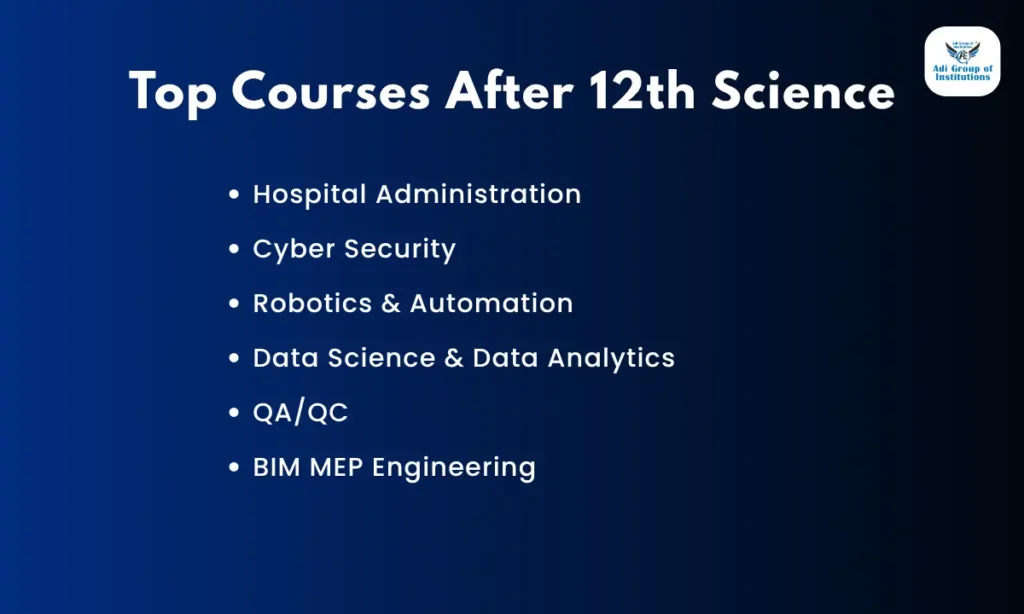
    Top Courses After 12th Science

    courses-after-12th-science

    1. Hospital Administration

    Hospital Administration is one of the best courses after 12th science. This course teaches you how hospitals are managed, from patient records and billing to staff coordination and legal compliance. If you want to work in hospitals and you love caring and communication, then this course is the perfect choice. 

    After this course, you can work in hospitals, medical colleges, clinics, and diagnostic centers. 

    Course duration

    6 Months & 1 Year

    Average salary – 3.5 LPA to 5 LPA

    2. Cyber Security

    Every company today faces cyber threats. Cyber security professionals are among the highest-paid IT workers in the world. In courses after 12th science, cyber security teaches you how to protect systems, detect threats, and respond to attacks. This course is suitable for those who have an interest in technology, maths and computers. As cyber threats and fraud are increasing, the demand for cybersecurity professionals is also increasing. The scope of cyber security in India and globally is growing faster than almost any other field

    After this course, you can work as a penetration tester, a cyber security analyst, network analyst, Security Engineer.

    Course duration

    6 Months & 1 Year

    Average salary – 5 LPA to 7 LPA

    3. Robotics & Automation

    Robotics and automation are the future of manufacturing and industrial work. This course teaches you how to programme, operate, and maintain robotic systems and automated machinery. You can choose the course if you have an interest in physics and maths. Industries like automobile manufacturing, electronics, and logistics are actively hiring automation technicians.

    You can work as a robotics engineer, an automation specialist, a robotics technician, a Mechanical Design Engineer and an embedded systems engineer.

    Course duration

    6 Months & 1 Year

    Average salary – 5 LPA to 8 LPA

    4. Data Science & Data Analytics

    Data is everywhere, and companies need people who can make sense of it. A diploma in Data Science or Data Analytics teaches you to collect, analyse, and present data in useful ways. You will learn tools like Excel, Python, SQL, and Tableau.

    This is one of the fastest-growing career fields globally. For science students who like numbers and problem-solving, this is a dream course.

    After this course, you can work as a data analyst, a data engineer, Business Intelligence (BI) Analyst

    Course duration

    6 Months & 1 Year

    Average salary – 6 LPA to 8 LPA

    5. QA/QC

    One of the most in-demand courses after 12th Science, a QA/QC diploma trains you to inspect and maintain quality standards in construction, oil and gas, and manufacturing industries. In just 6 months, you will learn practical skills like Non-Destructive Testing (NDT), welding inspection, ISO quality systems, and technical drawing reading. This course is ideal for Plus Two Science students, ITI graduates, and anyone planning to work in the Gulf countries.

    After this course, you can work as a Quality Engineer, Quality Analyst, or Quality Checker

    Course duration

    6 Months & 1 Year

    Average salary – 5 LPA to 8 LPA

    6. BIM MEP Engineering

    BIM MEP is one of the most exciting courses after 12th Science for students who want to work in the construction and engineering industry. BIM stands for Building Information Modelling — a technology used to design and plan buildings digitally before they are built. MEP stands for Mechanical, Electrical, and Plumbing — the three essential systems that make every building functional and safe. In this course, you will learn to use industry software like Revit and AutoCAD MEP to create detailed 3D models of these systems.

    After this course, you can work as a BIM Modeler, BIM Coordinator, or BIM Manager

    Course duration

    6 Months & 1 Year

    Average salary – 4 LPA to 7 LPA

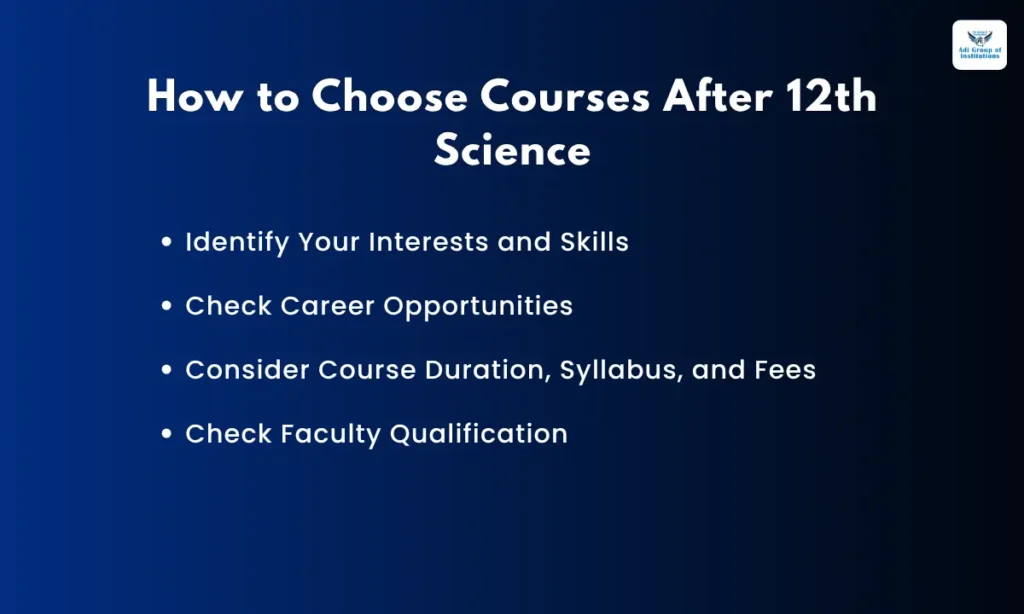
    How to Choose Courses After 12th Science?

    courses-after-12th-science

    1. Identify Your Interests and Skills

    The first thing to consider when selecting a course is finding your interests. Not everyone has every skill; some courses require certain skills and strengths. Only select a course that matches your interests and skills. When you study something you genuinely like, you will stay motivated, learn faster, and perform better at work.

    2. Check Career Opportunities

    Select a course that has job opportunities in the future. The simplest way to check job opportunities is to visit job portals. If you see 200+ job vacancies, the career is in demand and needs more people. So, while choosing a course, always check the scope of the career.

    3. Consider Course Duration, Syllabus and Fees

    Check the course duration and fees, and make sure that it is suitable for your situation. Sometimes the high-fee course doesn’t need to be the best. Make sure the syllabus is updated. Compare the fees with the syllabus.

    4. Check Faculty Qualification

    Check the qualifications of the faculty who teach you. Make sure the faculty has relevant industry experience in the field you are studying. An expert who has real experience can teach you what the industry needs.

    Frequently Asked Questions

    There is no single best course after 12th science; the best course depends on your interests and skills. So, find your interests and skills, and choose the best course suitable for you.

    Yes. Most of the courses listed here are 6 months to 1 year long. You can study all the courses after the Plus Two Science.

    Cyber Security is a great course for you if you enjoy working with computers, love solving problems, and have a curious mind that likes to find out how things work. It is one of the highest-paying and fastest-growing career fields in the world right now, with thousands of job openings in India and abroad every single year.

    Among the popular courses after 12th Science, Data Science, Cyber Security, and Cloud Computing are the highest paying in the IT sector.

    Start by understanding your interests and strengths, research the job market, and picking a course that leads to a career you will genuinely enjoy.

    Conclusion

    Choosing the right courses after 12th Science is one of the most important decisions you will make — but it does not have to be a difficult one. Start by understanding your interests and strengths, research the job market, and picking a course that leads to a career you will genuinely enjoy. There are many 6 months diploma courses in Kerala. Take the first step today, choose the course that fits you best, and start building the career you deserve.

    For-Admission
    Adi Group of Institutions

    Adi Institute is a leading educational institution in Kerala, committed to equipping learners with knowledge, skills, and innovation for the future. With experienced educators, modern facilities, and dedication to excellence, it offers a transformative learning experience that inspires growth, confidence, and career success.
    Related Posts

  • Best Courses After 12th Commerce in Kerala

    Best Courses After 12th Commerce in Kerala

    Best Courses After 12th Commerce in Kerala

    best-courses-after-12th-commerce

    Choosing the right course after completing 12th Commerce is one of the most important decisions in a student’s life. Many students and parents frequently ask, “Which is the best course for commerce students?” The answer depends on your interests, career goals, and skills.
    Today, commerce students have many opportunities beyond traditional degree courses. Whether you want to build a career in accounting, finance, business management, digital marketing, law, banking, or technology, there are several excellent options available.
    If you are looking for the best courses after 12th commerce in Kerala, this guide will help you understand the available choices and choose a course that matches your future plans.

    Why Choosing the Right Course After 12th Commerce Matters

    The course you choose after Plus Two can influence your future career path. A good course helps you gain practical knowledge, develop professional skills, and improve job opportunities. So you have to double-check before selecting a course.
    Before choosing a course, consider:

    • Your interests and strengths
    • Career opportunities
    • Course duration and fees
    • Future scope and salary potential
    • Higher education options

    Best Short-term Courses After 12th Commerce

    courses-after-12th-commerce

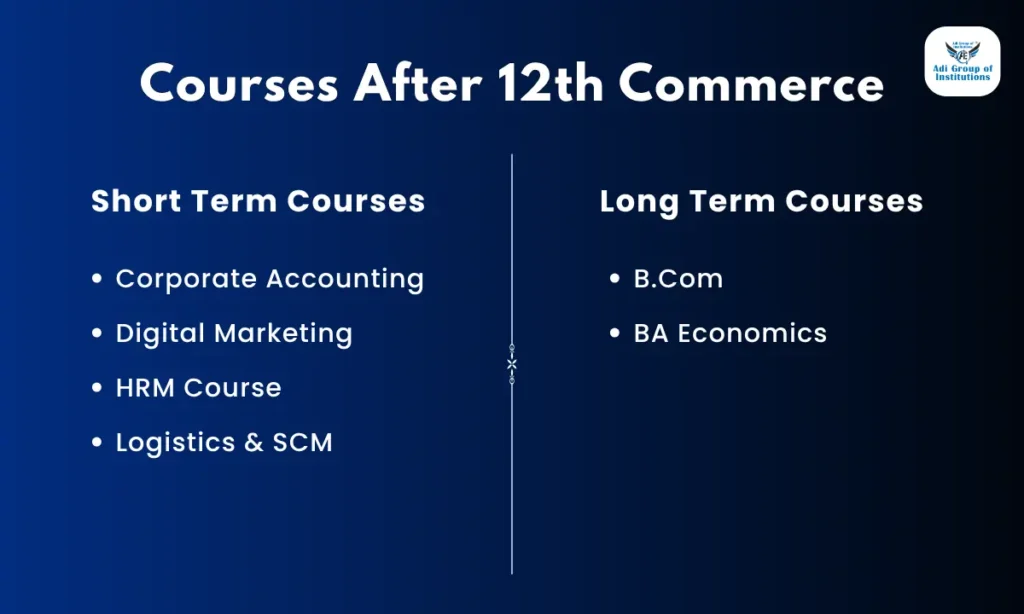
    If you need a quick job after plus two, short term courses can be a smart choice. Many commerce students in Kerala choose 6 months diploma courses in Kerala to build practical, job-ready skills without spending years in a classroom. These courses focus on practical skills and can be completed in a short period of time. They help students become job-ready faster and open opportunities in different industries.

    1. Accounting Course

    After completing 12th commerce, students can study an accounting course in Kerala. Accounting is a career every business needs. In Plus Two Commerce, you already studied accounting basics, but when it comes to real-world application, practical skills are needed. By studying a short term accounting course, you learn the practical skills and industry tools in accounting.

    Course duration

    6 Months & 1 Year

    Average salary – ₹15,000 to ₹20,000 per month for Freshers in Kerala

    2. Digital Marketing

    In the courses after 12th commerce, Digital marketing focuses on promoting businesses through online platforms such as Google, social media, websites, and email marketing. Students learn SEO, social media marketing, content marketing, and online advertising. After completing a digital marketing course, students can work as a digital marketing executive, SEO executive, or social media executive.

    Course duration

    6 Months & 1 Year

    Average salary – ₹15,000 to ₹20,000 per month for Freshers in Kerala

    3. HRM Course

    Human Resource Management (HRM) is a good option for students looking for courses after 12th commerce. This course teaches how to manage employees, recruitment, training, payroll, and workplace communication. Students learn the skills needed to handle people and support business growth. After completing the course, they can work as HR assistants, recruiters, payroll executives, or HR coordinators in different industries. As companies continue to hire more employees, the demand for skilled HR professionals is growing. HRM is a suitable career choice for students who enjoy working with people and have good communication skills.

    Course duration

    6 Months & 1 Year

    Average salary – ₹14,000 to ₹20,000 per month for Freshers in Kerala

    4. Logistics & Supply Chain Management

    Logistics and Supply Chain Management (SCM) is one of the popular courses after 12th commerce for students who are interested in business operations and transportation. This course teaches how goods move from manufacturers to customers in a smooth and efficient way. Students learn about warehousing, inventory management, shipping, and supply chain planning. After completing the course, they can work as logistics coordinators, supply chain executives, warehouse managers, or procurement officers. The logistics industry is growing rapidly, creating many job opportunities in India and abroad. Logistics career is suitable for those who enjoy planning, organizing, and managing processes.

    Course duration

    6 Months & 1 Year

    Average salary – ₹15,000 to ₹20,000 per month for Freshers in Kerala

    Best Long-term Courses After 12th Commerce

    If you don’t need to support your family for the next 4 years, you can choose a long-term course after the Plus Two courses in Kerala. These courses give you more time to learn important subjects and develop strong career skills.

    1. Bachelor of Commerce (BCom)

    Bachelor of Commerce (BCom) is one of the most popular courses after 12th commerce. This degree helps students build strong knowledge in accounting, finance, taxation, business management, and economics. It provides a solid foundation for higher studies such as MCom, MBA, CA, CMA, and ACCA. After completing BCom, students can find jobs in banks, finance companies, accounting firms, and corporate offices. Common career options include accountant, financial analyst, tax assistant, and business executive. BCom is a good choice for students who want a stable career in the commerce and business field.

    Course duration

    4 Years

    Average salary – ₹15,000 to ₹25,000 per month for Freshers in Kerala

    2. Bachelor of Economics (BA Economics)

    BA Economics is one of the most valuable courses after 12th commerce for students who want to understand how money, markets, and economies work. This course teaches topics such as economic policies, banking, finance, trade, and data analysis. Students develop strong analytical and problem-solving skills during the program. After completing a BA in Economics, they can work in banks, financial institutions, research organizations, and government departments. Common career options include economist, financial analyst, research assistant, and banking professional. It is a good course for students who are interested in finance, business, and economic development.

    Course duration

    2 years

    Average salary – ₹15,000 to ₹25,000 per month for Freshers in Kerala

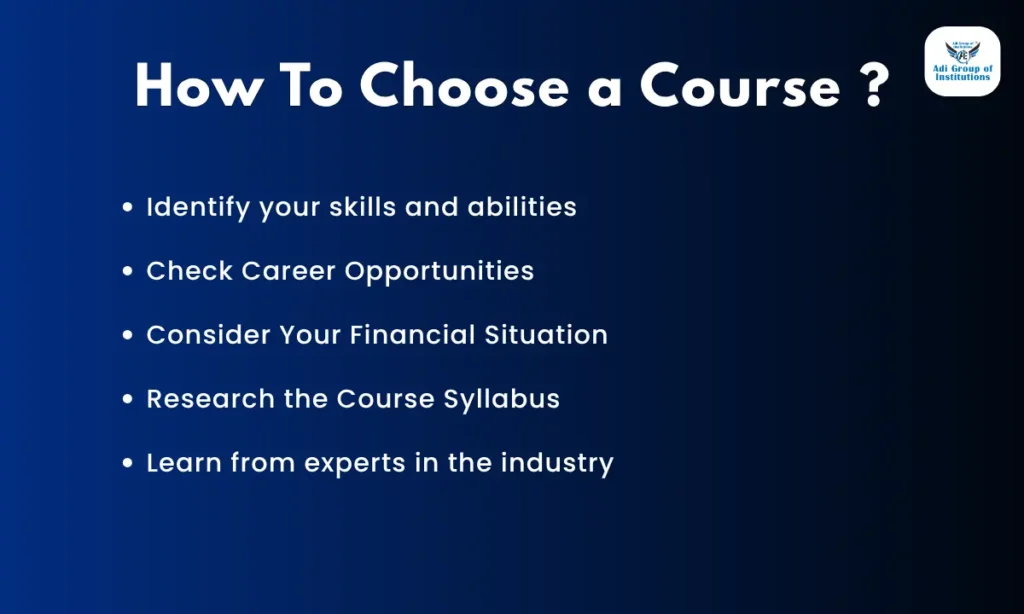
    How To Choose a Course ?

    courses-after-12th-commerce

    1. Identify your skills and abilities

    Choose a course that matches your skills and the subjects you enjoy studying. Learning becomes easier and more enjoyable when you genuinely like the field.

    2. Check Career Opportunities

    Before selecting a course, research the jobs available after the course. A good course should lead to career opportunities that match your goals.

    3. Consider Your Financial Situation

    Some students need a job quickly, while others can spend more time studying. Choose a short-term or long-term course based on your family’s financial needs and future plans.

    4. Research the Course Syllabus

    Read the syllabus and understand what you will learn. This helps you avoid choosing a course based only on its name or popularity.

    5. Learn from experts in the industry

    Learn from the expert mentors who are working in the industry. Their knowledge and experience can help you understand career opportunities, industry trends, and the skills needed for success.

    Frequently Asked Questions

    Yes. Short-term courses such as Accounting, Digital Marketing, HRM, and Logistics can help you develop practical skills and find entry-level jobs faster.

    The best course depends on your interests and career goals. Popular options include BCom, BBA, BA Economics, Accounting, Digital Marketing, HRM, and Logistics & Supply Chain Management.

    Courses related to accounting, finance, business management, digital marketing, and logistics offer good career opportunities. The best option depends on your skills and interests.

    Start by identifying your interests, strengths, career goals, and financial situation. Research the course syllabus, job opportunities, and future growth before making a decision.

    Conclusion

    There are many excellent courses after 12th commerce available for students in Kerala. The right course depends on your interests, skills, career goals, and financial situation. Some students may prefer short-term courses that help them get a job quickly, while others may choose long-term degree programs for better career growth in the future. Before making a decision, take time to research the course, understand the career opportunities, and seek guidance from experienced professionals. Choosing the right course today can help you build a successful and rewarding career tomorrow.

    For-Admission
    Adi Group of Institutions

    Adi Institute is a leading educational institution in Kerala, committed to equipping learners with knowledge, skills, and innovation for the future. With experienced educators, modern facilities, and dedication to excellence, it offers a transformative learning experience that inspires growth, confidence, and career success.
    Related Posts

  • After BCom Which Course is Best? Top Courses to Choose in 2026

    After BCom Which Course is Best? Top Courses to Choose in 2026

    After BCom Which Course is Best? Top Courses to Choose in 2026

    After BCom Which Course is Best

    After BCom Which Course is Best?

    If you ask, after bcom which course is best? The answer is simple, the best course after bcom is based on your interest and career plans.
    After completing BCom, many students have doubts about which course is the best to study for a better career. It is because of the lack of knowledge and guidance. But in this blog, you will get a clear idea about the best courses to take after Bcom.

    Short-Term Courses or Long-Term Courses

    After completing BCom, most students do not have enough skills to enter a job. So there are two options, either you can study a short-term course or go for long-term courses, it depends on your financial and family situation.

    If you don’t have time for 2 to 4 years, or you want a quick job to support your family financially, then studying short-term courses is the best option. These courses are job-oriented, which gives you the skills needed for a job in a short time. Only take the short term course if you are interested in that field.

    If you want to enter higher positions and you have enough time, budget, and your family does not need your support for 2- 4 years, you can take a long-term course. Before entering the course, ensure that there are career opportunities in the field.

    The right option depends on your career plans, financial situation, and learning interests.

    Best 3 short-term Courses After BCom For a Quick Job in 2026

    best-courses-after-bcom

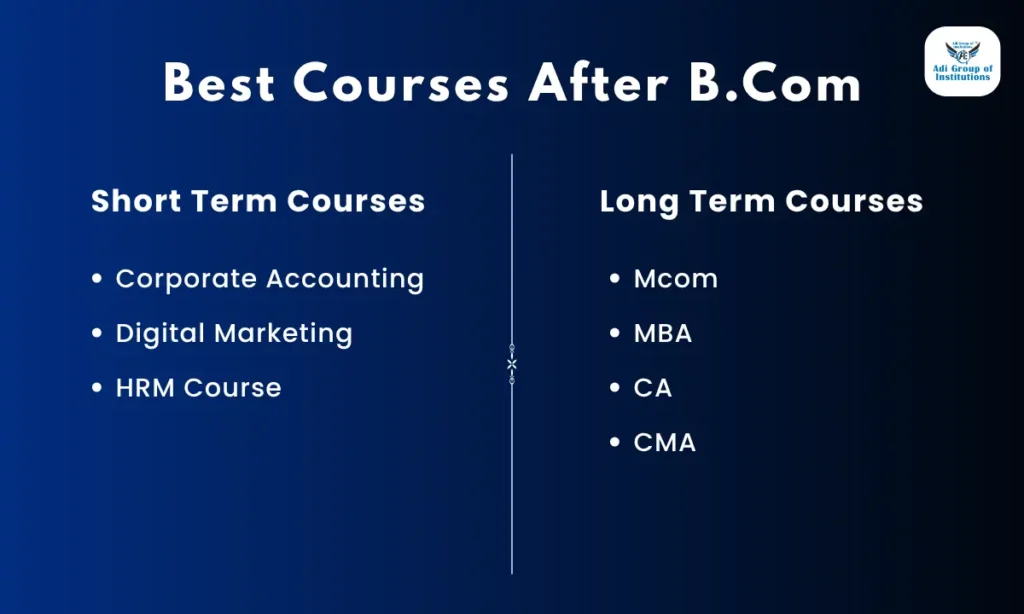
    1. Corporate Accounting

    If you are thinking after bcom which course is best? The Accounting course is the best option if you need a quick job within a short time. In BCom, you already studied accounting, but to enter a job, you need practical skills. The short-term accounting course covers industry-relevant tools like Tally, SAP, and Excel. Don’t just take the course, considering the accounting in B.com, consider the real-world nature of accounting jobs. The scope of accounting is growing wider every year

    In Kerala, there is a steady demand for skilled accountants in businesses, CA firms, hospitals, supermarkets, and private companies. Students with practical accounting knowledge often get jobs faster.

    Course duration

    3 – 12 months

    Career Opportunities include Accountant, Tax Assistant, GST Executive, etc

    Average salary – ₹2–5 LPA for freshers, growing fast with experience

    2. Digital Marketing

    Digital marketing is becoming one of the most in-demand career options in 2026. Almost every business now needs online marketing. If you are interested in business, marketing, technology and have good creativity, digital marketing is the best course after B.com. The course mainly includes marketing basics, SEO, Meta ads and Google ads. Many BCom students in Kerala are choosing digital marketing because the industry is growing fast and offers good career growth.

    Course duration

    3 – 12 months

    Career Opportunities include Accountant, Tax Assistant, GST Executive, etc

    Average salary – ₹2–5 LPA for freshers, growing fast with experience

    3. HRM Course

    If you are searching for, after BCom which course is best? For people-oriented careers, HRM is a good option. This course is suitable for students who enjoy communication, teamwork, recruitment, and workplace management. Every company needs HR professionals to manage employees and recruitment activities.

    Course duration

    3 – 12 months

    Career Opportunities include HR Executive, Talent Acquisition Executive and HR Manager.

    Average salary – ₹3–6 LPA for freshers, growing fast with experience

    Top Long-term Courses After BCom

    1. Mcom

    The most suitable post-graduate course after B.Com is M.Com. If you are interested in teaching, accounting, banking, and analysis, the M.com course is the best option. You will study the advanced syllabus from B.Com. MCom is also useful if you are planning for UGC NET or government-related careers.

    Course duration

    2 years

    Career Opportunities include Lecturer, Accountant, Banking Professional, Financial Analyst

    Average salary – ₹4–6 LPA for freshers, growing fast with experience

    2. MBA

    MBA is one of the most popular postgraduate courses in India. If you want to enter a management and leadership role, studying MBA is the best option after B.Com. An MBA from a good college can provide strong career growth and salary opportunities. Many students choose MBA when they think about after BCom which course is best for management and leadership careers.

    Course duration

    2 years

    Career Opportunities include Marketing Manager, HR Manager, Business Analyst, Sales Manager, Operations Executive

    Average salary – ₹6–10 LPA for freshers, growing fast with experience

    3. CA

    If your goal is finance, taxation, or auditing, and you are searching after BCom which course is best, CA is one of the most respected professional qualifications in India. The pass rate in CA Final is under 15%. But BCom gives you a strong foundation in accounts and finance. If you have a genuine interest, real discipline, and long-term commitment, CA is absolutely achievable.

    Course duration

    3 to 5 years

    After completing CA, you can work as an auditor, tax consultant, finance manager, or CFO in top companies, start your own CA practice, or even build a career abroad.

    Average salary – ₹7 Lakhs – ₹12 Lakhs

    4. CMA

    For students interested in cost management, budgeting, and financial planning inside large companies. CMA is a strong alternative. It is challenging, but structured well, and the placement opportunities in manufacturing and corporate sectors are solid.

    Course duration

    3 years

    After completing CMA, you can work as a cost accountant, financial analyst, or budget manager in manufacturing, banking, and corporate companies across India.

    Average salary – ₹4 Lakhs – ₹7 Lakhs

    5. ACCA

    ACCA is the global equivalent of CA. If your goal is to work abroad, in the UK, the Middle East, Singapore, or Australia, ACCA is the qualification you need.
    It is recognised in over 180 countries. For BCom students in Kerala who dream of a career in the Gulf or Europe, ACCA is genuinely worth considering. Your BCom exempts you from several ACCA papers, which saves you both time and money.

    Course duration

    2 to 4 years

    After completing ACCA, you can work as an auditor, tax consultant, financial analyst, or CFO in top companies globally.

    Average salary: ₹4 to ₹8 LPA in India; significantly higher abroad

    Which Course Suits You?

    > If You Like Numbers, Accounts, and Finance

    • Corporate Accounting (short-term, quick job)
    • CA (long-term, highest credential)
    • CMA (long-term, cost & management focus)
    • M.Com (long-term, academic route)
    • ACCA (long-term, international finance)

    > If You Like People, Teams, and Workplace Management

    • HRM Course (short-term, quick job)
    • MBA — HR specialisation (long-term, senior roles)

    > If You Like the Business, Technology, and Creativity

    • Digital Marketing (short-term, quick job)
    • MBA — Marketing specialisation (long-term, brand/strategy roles)

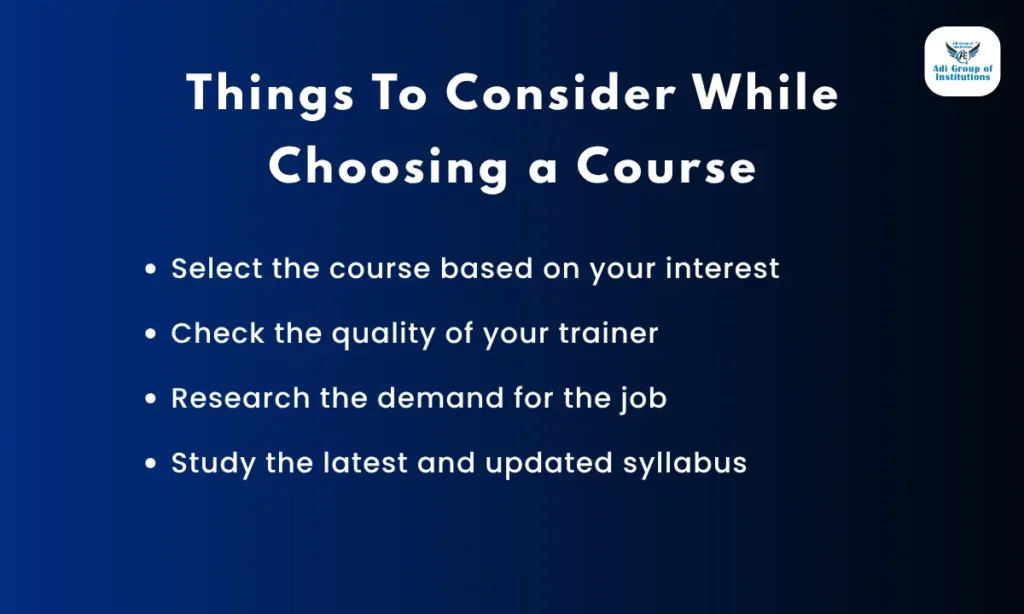
    Things To Consider While Choosing a Course

    1. Select the course based on your interest

    Choose a course that you are genuinely interested in. If you enjoy numbers, go for accounting or finance courses. If you like people and communication, HR or marketing suits you better. When you study something you enjoy, you will learn faster and perform better in your job.

    2. Check the quality of your trainer

    A good trainer makes a big difference in how well you learn. Before joining any course, find out about the trainer’s experience and background. Read reviews from past students. If possible, attend a free demo class before paying the fees.

    3. Research the demand for the job

    Before choosing a course, check how many job openings are available for that role. Visit job websites like Naukri or LinkedIn and search for the job title. If you see many openings in your city or state, the demand is good, and your chances of getting a job are higher.

    4. Study the latest and updated syllabus

    Always check the course syllabus before enrolling. Make sure the topics are updated and relevant to today’s job market. For example, a digital marketing course should cover AI tools, and an accounting course should include the latest GST updates. An outdated syllabus will not help you in a modern workplace.

    Frequently Asked Questions

    The best short-term courses after BCom for a quick job in Kerala are Corporate Accounting, Digital Marketing, and HRM. These courses take only 6 to 12 months to complete and have strong job demand across Kerala. Choose the one that matches your interests, and you will find a job much faster.

    Yes, Digital Marketing is a great option after BCom. Your BCom background gives you a natural understanding of business, customers, and markets, which is exactly what Digital Marketing needs. With strong job demand across Kerala and good salary growth, it is one of the smartest short-term courses you can choose after BCom.

    Both are good; it depends on your current situation. If you need a job quickly, a short-term course is the right choice. If you can study for 2 more years and have a clear career goal, a long-term course like an MBA or CA will take your career much further.

    Conclusion

    After BCom, you have more good options than you think — from short-term courses like Digital Marketing and Corporate Accounting to long-term qualifications like MBA, CA, and ACCA. If you are still asking after BCom which course is best, the honest answer is — it is the one that fits your interest, your situation, and your career goal. If you need a job quickly, start with a short-term course. If you can study further, go for post-graduation.

    For-Admission
    Adi Group of Institutions

    Adi Institute is a leading educational institution in Kerala, committed to equipping learners with knowledge, skills, and innovation for the future. With experienced educators, modern facilities, and dedication to excellence, it offers a transformative learning experience that inspires growth, confidence, and career success.
    Related Posts

  • Top – 6 Months Diploma Courses in Kerala With High Salary

    Top – 6 Months Diploma Courses in Kerala With High Salary

    Top 6 months diploma courses in Kerala

    Top – 6 Months Diploma Courses in Kerala With High Salary

    Choosing a course after Plus Two or a degree is one of the biggest decisions of your life. Now, students completed plus two are confused whether to study a traditional degree or a 6-month course. Also, students completed their degree, confused about going for a job or a post-graduation.

    Skill is the most important factor now to get a job. 6 months diploma courses in Kerala are the best option to gain practical skills in a short time. There are many options available in 6 months diploma courses in Kerala now. Choosing the right course according to your skills and job demand is very difficult.
    Here you can find the top 6 months diploma courses in Kerala for 2026 and the future. Choose the right course according to your skills and interests.

    Why Study Diploma Courses in Kerala?

    Practical skills are needed to do a job. But after studying plus two and a degree, students can’t get the practical skills that are needed for a job. That is a limitation of our education system.
    But diploma courses are focused on building practical skills that make one job-ready after the course. Comparing skilled courses vs traditional degrees, diploma courses are cost effective. Also, the duration of the courses is short, so if you want a quick job, studying 6 months diploma courses in Kerala is the better option.

    Best 6 Months Diploma Courses in Kerala

    6-months-diploma-courses-in-Kerala

    1. Oil & Gas

    Oil and gas is one of the best 6 months diploma courses in Kerala. You can study this course after Plus Two or a degree. If you are interested in working in the petroleum industry and in Gulf countries, the oil & gas course is the best option. In this course, you can gain skills in plant operations, safety guidelines, quality assurance, and soft skills. The work location may be in an onshore or offshore environment.

    Course eligibility

    • Plus two pass – any stream
    • Degree holders – any discipline
    • Students with a technical background (ITI, Polytechnic diploma in Mechanical, Electrical, or Civil) have an added advantage for certain roles

    Career options after this course: Process operator, safety officer (entry level), plant technician, HSE coordinator.
    Average salary – Average salary after oil & gas is 4 – 10 LPA, depending on the company and country.

    2. Digital Marketing

    Digital marketing is the marketing through digital platforms. By the advancements of digital technology. All businesses now need digital marketing. In this course, you will study the basics of marketing, social media marketing, SEO, Meta ads, Google Ads, and other digital tools. In 6 months diploma courses in Kerala, digital marketing is one of the courses that you can start earning even while you are studying through freelance work. If you want to enter the IT field without coding knowledge, digital marketing course in Kerala is the perfect choice.

    Course eligibility

    • Plus Two pass — Any stream.
    • Graduates – Any degree
    • Basic computer knowledge – Only basic computer knowledge is needed to study the course.

    Career options after this course: After the digital marketing course, you can work as a digital marketing executive, an SEO Analyst, a social media executive, a freelancer, or you can start your own business.
    Average salary – You can earn 3 – 10 LPA based on your skills and abilities. Also, you can earn unlimited income through freelance work.

    3. Logistics and Supply Chain Management

    Logistics and Supply Chain Management is the process of moving goods from one place to another, efficiently, on time, and at the right cost. The scope of Logistics and Supply Chain Management in 2026 is very strong. The rapid growth of e-commerce, healthcare, manufacturing, retail, and Gulf industries has created a huge demand for trained logistics professionals. So studying logistics and supply chain management course is the best option to work in a warehouse. 

    Course eligibility

    • Plus Two pass – Any stream.
    • Graduates – Any degree
    • Basic computer knowledge – You should be comfortable using a laptop and basic office tools like Excel.

    Career options after this course – After completing a Logistics and Supply Chain Management course, you can work as a Logistics Coordinator, Warehouse Executive, Procurement Assistant, or Inventory Control Executive.

    Average salary in Kerala: ₹3–6 LPA for freshers, growing fast with experience

    4. Hospital Administration

    In recent years, the number of hospitals has increased drastically, and the demand for the hospital administration course has also increased. Hospitals need trained professionals to manage the operations. If you want to work health care field without a science background, the hospital administration course is the best 6 months diploma course in Kerala.

    Course eligibility

    • Plus Two pass – Any stream is accepted
    • Degree holders – Any degree qualifies. BA, BCom, BSc, BBA — all are welcome
    • Basic computer knowledge – Comfortable using a laptop and basic office tools

    Career options after this course – After this course, you are eligible for roles like Hospital Administrator, Patient Relationship Officer, Insurance Coordinator, Medical Records Executive, Quality Executive, Operations Executive, and Front Office Executive

    Average salary in Kerala: ₹3–5 LPA for freshers, growing fast with experience

    5. Accounting

    A Diploma in Accounting teaches you how to manage a business’s finances — practically and professionally. You learn real tools like SAP, Tally ERP, GST filing, income tax basics, and financial record keeping. It is one of the most job-oriented courses in Kerala. Because every business in every sector needs accounting support. So if you’re looking 6 months diploma courses in Kerala, accounting course is a good option.

    Course eligibility

    • Plus Two pass – Commerce preferred
    • Graduates – BCom preferred

    Career options after this course – After completing an Accounting course, you can work as an Accountant, GST Assistant, Billing Executive, Tax Assistant, Finance Executive, or Junior Accountant in a CA firm.

    Average salary in Kerala – ₹2–5 LPA for freshers, growing fast with experience

    6. Cyber Security

    Cybersecurity is the practice of protecting computers, networks, and data from hackers and cyber attacks. A Diploma in Cyber Security course teaches you how to protect digital systems. You learn how hackers think, how attacks happen, and how to stop them before they cause damage. Every company that uses the internet needs a Cyber Security professional, making this one of the most future-proof and high-salary career fields available today.

    Course eligibility

    • Plus Two pass – Science or Computer Science background is an advantage, but not mandatory
    • Degree holders – BCA, BSc Computer Science, BTech, or any degree is accepted
    • Basic computer knowledge – You should be comfortable using a computer and the internet

    Career options after this course – After completing a Cyber Security course, you can work as a Cyber Security Analyst, Ethical Hacker, Penetration Tester, SOC Analyst, Information Security Officer, IT Security Consultant, Cyber Forensics Analyst, or System Administrator

    Average salary in Kerala – ₹4–5 LPA for freshers, growing fast with skills & experience

    7. Data Science

    In 6 months diploma courses in Kerala, data science is one of the best if you like technology and maths. A diploma in Data Science teaches you how to collect, analyse, and interpret large amounts of data. Every industry, from healthcare and banking to retail and IT, is collecting massive amounts of data and needs trained professionals to analyse it and turn it into useful decisions.

    Course eligibility

    • Plus Two pass – Science or Mathematics background is an advantage
    • Degree holders – BSc, BCA, BTech, BCom, BBA – any degree is accepted
    • Basic computer knowledge – Comfortable using a laptop and the internet

    Career options after this course – After completing a Data Science course, you can work as a Data Analyst, Business Intelligence Analyst, Data Engineer, Data Visualisation Specialist, Database Administrator, or Research Analyst.

    Average salary in Kerala – ₹3.5–7 LPA for freshers, growing fast with skills & experience

    8. HRM Course

    6 months Diploma in Human Resource Management teaches you how to manage people in a professional work environment. You learn recruitment, payroll, employee relations, HR laws, and the tools used in modern HR departments. Every organisation that has employees needs an HR team, making Human Resource Management one of the most stable and consistently in-demand career fields you can enter today.

    Course eligibility

    • Plus Two pass – Any stream is accepted. Commerce, Science, or Humanities
    • Degree holders – Any degree qualifies. BA, BCom, BSc, BBA — all are welcome
    • Good communication skills – English communication is important for HR roles

    Career options after this course – After completing an HRM course, you can work as an HR Executive, Recruitment Coordinator, Payroll Executive, HR Administrator, Training Coordinator, Employee Relations Officer, Performance Management Executive, or HR Generalist.

    Average salary in Kerala – ₹2.5–7 LPA for freshers, growing fast with skills & experience

    How to Choose a Diploma Course in Kerala?

    1. Check your interest and the job market

    The first thing to check is your interest in that field. Ask yourself, do I genuinely like this field? To find an answer, understand the nature of the job and ask whether you would work that job without a salary. If yes, you are interested in that field and it’s your passion.
    Then check the job demand. If the job has no future demand. Don’t take that course.

    3. Consider the mentor’s experience

    Your trainer matters more than you think. A mentor who has actually worked in that industry will teach you things no textbook can.
    Before joining, ask the institute who is teaching this course and what their background is

    4. Don’t Decide Based on Fees Alone

    The cheapest course is not always the best choice. And the most expensive one is not always worth it either.
    Focus on the value – what you learn, who teaches, and what support you get after the course. That is what your fees should buy you.

    5. Check the institute’s placement & service

    Check the institute’s placement record before joining, ask for real examples of where their students are working, and find out what career support they offer after the course ends.

    Frequently Asked Questions

    Yes, studying diploma courses after plus two is the best option that will get you a quick job and build real job skills. So you will get a job within 1 year after completing plus two.

    For Plus Two commerce students, Accounting, Digital Marketing, and HRM are the best 6 months diploma courses in Kerala.

    Yes, you can, many students do get jobs after 6 month diploma courses. Choose the right course, study from a good institute, and build real practical skills.

    To choose the best institute, check four things: the syllabus, the trainer’s experience, the placement record, and the support they offer after the course.

    The best high-salary courses in Kerala right now are Data Science, Cyber Security, Digital Marketing, Oil and Gas, and Logistics and Supply Chain Management – these fields have strong job demand both in Kerala and the Gulf, and salaries grow fast with experience.

    Conclusion

    These are the top 6 months diploma courses in Kerala. Choose the right course according to your skills and interests. Don’t choose a course just because your friend or relative suggested it. Whichever course you choose, make sure you focus on building real, practical skills – because employers today hire people who can do the job, not just people who have a certificate.

    For-Admission
    Adi Group of Institutions

    Adi Institute is a leading educational institution in Kerala, committed to equipping learners with knowledge, skills, and innovation for the future. With experienced educators, modern facilities, and dedication to excellence, it offers a transformative learning experience that inspires growth, confidence, and career success.
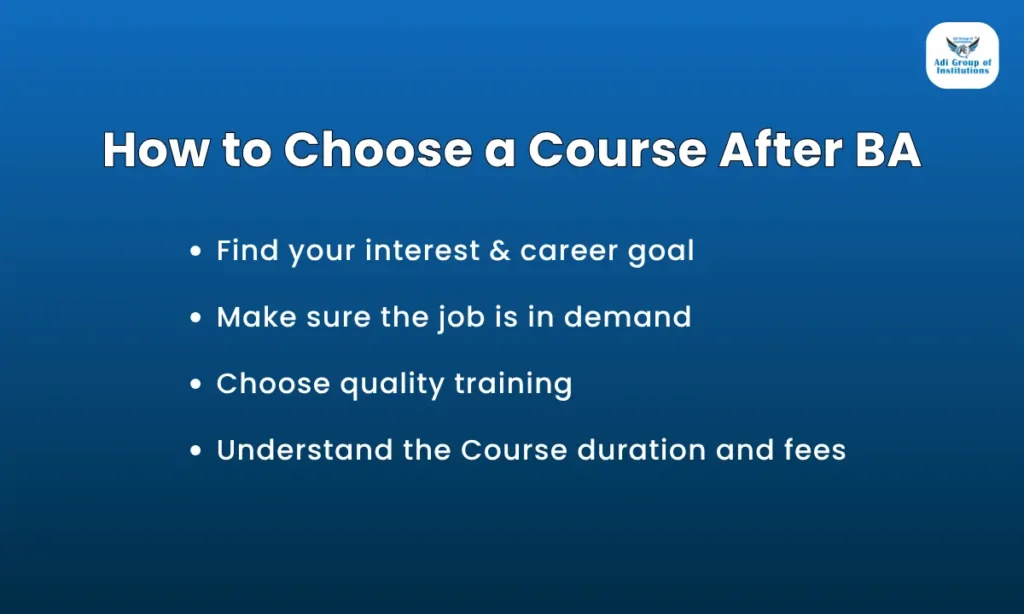
    Related Posts

Call Now Button